
What Is a Customer Data Platform?
A customer data platform (CDP) is a unified customer database that collects, cleans, and unifies data from every channel and touchpoint into a single customer profile — making that profile accessible to marketing, sales, service, and now, AI agents.
That last part is new. For a decade, CDPs were built for humans: marketers building segments, analysts pulling reports, campaign managers scheduling sends. In 2026, the definition is being reset. A CDP is no longer just a platform humans query — it's the data foundation that AI agents access in real time to make autonomous decisions about every customer interaction.
The 2026 Reset: From Human Interface to Agent Infrastructure
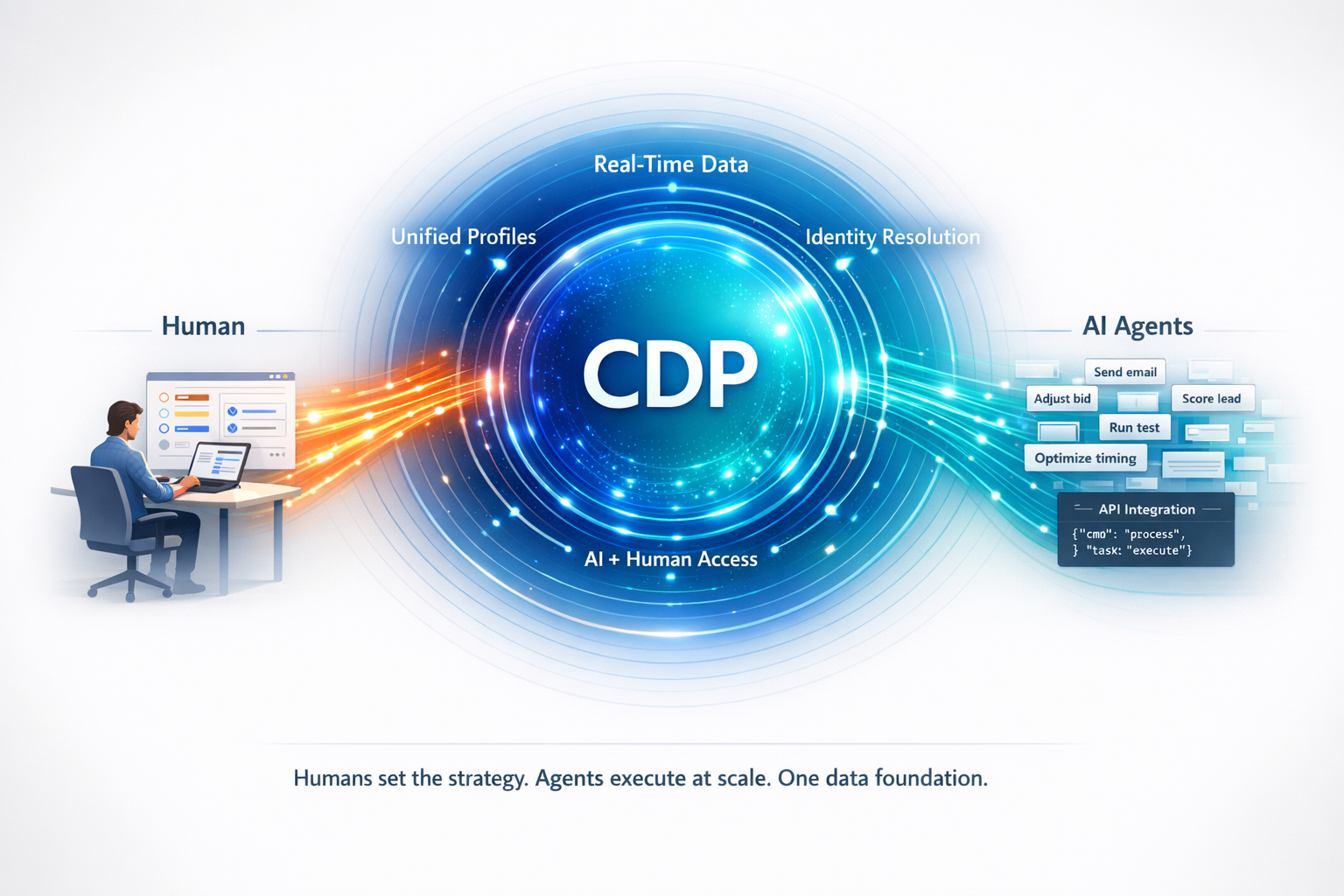
The shift is fundamental. When agentic marketing systems plan, execute, and optimize campaigns autonomously, they need three things from a CDP that the old definition never required:
1. Programmatic access, not just a UI
Human marketers click through dashboards. AI agents call APIs. A modern CDP must expose every capability — profiles, segments, activations, insights — through complete, well-documented APIs and CLIs. This is why platforms like Treasure Data ship Treasure Code (tdx CLI) alongside the visual interface: because the next user of your CDP isn't a person — it's an agent.
2. Real-time data, not batch snapshots
A human marketer can wait for a nightly batch update. An AI agent making real-time decisions for millions of customers cannot. The 2026 CDP must stream unified profiles in real time — not just collect data in real time, but make it queryable in real time, so agents can act on what a customer did 30 seconds ago, not 24 hours ago.
3. Governance that works at machine speed
When humans access customer data, you review their permissions quarterly. When AI agents access customer data thousands of times per second, you need RBAC, audit logging, consent enforcement, and compliance guardrails that operate at machine speed — automatically, without a human in the loop.
This doesn't mean the old definition is wrong. A CDP still unifies data, resolves identities, and powers personalization. But in 2026, a CDP that only serves humans is already falling behind. The platforms that win are the ones that serve both — the marketer building strategy and the agent executing it.
How Does a CDP Work?
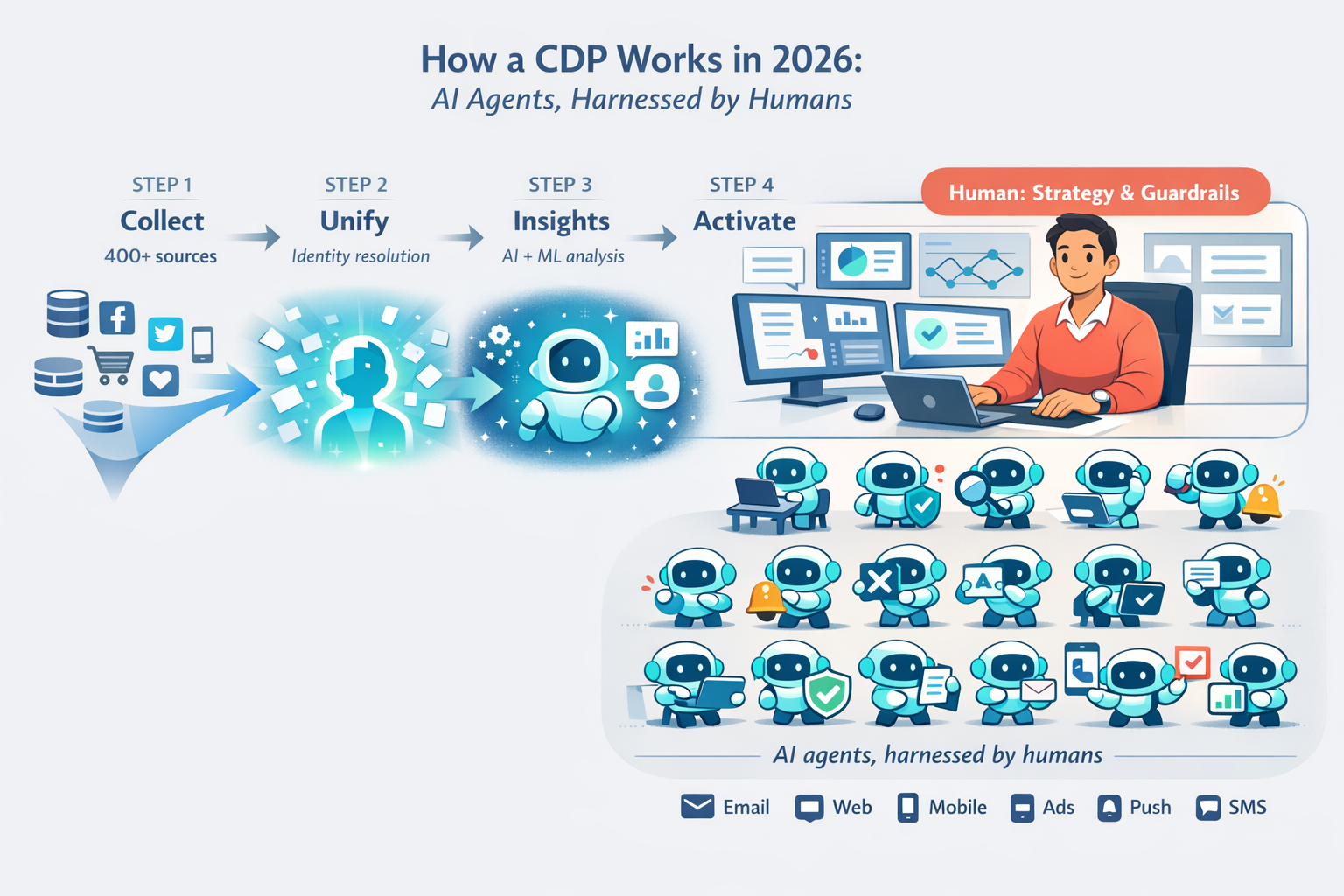
Whether accessed by a human or an AI agent, a CDP operates through four core steps:
Collect, clean, and enrich customer data
A CDP collects data from every channel and touchpoint — websites, mobile apps, social media, CRM, e-commerce, point-of-sale, and more. It then cleans and enriches this data automatically, resolving duplicates and filling gaps before storing it on one centralized platform. Treasure Data connects to 400+ data sources out of the box for rapid deployment.
Unify customer profiles through identity resolution
Using AI and machine learning, a CDP automates identity resolution — stitching multiple data points from different devices, channels, and sessions into a single, persistent customer profile. This unified customer view is the foundation for personalization, journey orchestration, and now, autonomous agent actions.
Derive customer insights
A CDP uses AI and machine learning to analyze millions of data points — decoding customer behavior, predicting future actions, and identifying segments that humans would never find manually. These insights power both human-led strategy and AI-driven segmentation.
Activate across every channel
Insights become action. A CDP orchestrates personalized experiences across email, web, mobile, advertising, and service channels — either through human-configured campaigns or through AI agents that autonomously select the next-best action for each customer in real time.
What Are Common CDP Use Cases?
A CDP serves every customer-facing team — and increasingly, the AI agents that operate alongside them:
Marketing
- Campaign orchestration — Track customers across channels, personalize experiences, and orchestrate the full customer journey from a single platform
- AI-powered personalization — Move beyond static segments to 1:1 experiences driven by real-time behavioral data
- Autonomous email optimization — Let AI agents determine the right message, timing, and offer for each individual
- Media suppression and optimization — Sync conversion data back to ad platforms in real time to suppress already-converted customers, build high-value lookalikes, and stop wasting spend on audiences that already bought. This alone can save millions in annual ad budget
B2B sales and marketing
- Account-based engagement — Segment and engage prospects within target accounts using firmographic + behavioral data
- Predictive scoring — Identify which accounts are ready to buy and prioritize outreach accordingly
IT and data engineering
- Data unification and governance — Centralize customer data, enforce compliance, and eliminate silos across enterprise systems
- API-first architecture — Expose unified profiles to any downstream system, including AI agent frameworks, through complete APIs and CLI tools
Customer service
- Instant context — Surface a customer's full history to support agents (human or AI) so they can resolve issues faster
- Churn prevention — Use predictive scoring to spot at-risk customers and trigger retention actions automatically
Privacy, compliance, and consent
- GDPR / CCPA / APPI compliance — A CDP centralizes consent records, data subject access requests (DSARs), and deletion rights into one system — so compliance isn't a per-tool effort but an infrastructure guarantee
- Consent-aware activation — Every segment, campaign, and AI agent action is filtered through real-time consent status. If a customer withdraws email consent at 2pm, the 3pm campaign respects it — automatically, across every channel
- Data residency and access control — Enterprise CDPs enforce where data is stored (regional data residency), who can access it (RBAC), and how it's used (audit trails) — critical when AI agents are accessing customer data at machine speed
AI agents and autonomous systems
- Real-time profile access — AI agents query unified customer profiles via API to make personalization and decisioning calls at millisecond speed — no human in the loop
- Agentic campaign execution — Agents autonomously plan, launch, and optimize campaigns across channels, using the CDP as their single source of truth for every customer interaction
- Autonomous next-best-action — Agents evaluate each customer's full profile in real time and select the optimal action — the right offer, on the right channel, at the right moment — without waiting for a human to build the rule
CDP vs CRM vs DMP: How They Compare
CDPs, CRMs, and DMPs each manage customer data — but for different purposes, with different data types, at different speeds.
| Capability | CDP | CRM | DMP |
|---|---|---|---|
| Primary purpose | Unify all customer data for marketing, AI, and activation | Manage sales interactions and relationships | Segment anonymous audiences for ad targeting |
| Data types | First, second, and third-party; known + anonymous | First-party only; known contacts | Second and third-party; anonymous |
| Identity resolution | AI-powered, cross-device, persistent IDs | Manual or basic matching | Cookie-based, temporary |
| Data retention | Long-term, full history | Long-term, interaction history | Short-term, session-based |
| AI / agent access | Full API + CLI + real-time streaming | Limited API access | Not designed for AI agents |
| Best for | Personalization, AI decisioning, journey orchestration | Sales pipeline, relationship tracking | Programmatic advertising, lookalike audiences |
A CDP doesn't replace a CRM or DMP — it unifies the data from both. Your CRM feeds sales data into the CDP, your DMP feeds audience data, and the CDP creates a unified profile that both humans and AI agents can act on.
How AI Is Transforming CDPs in 2026
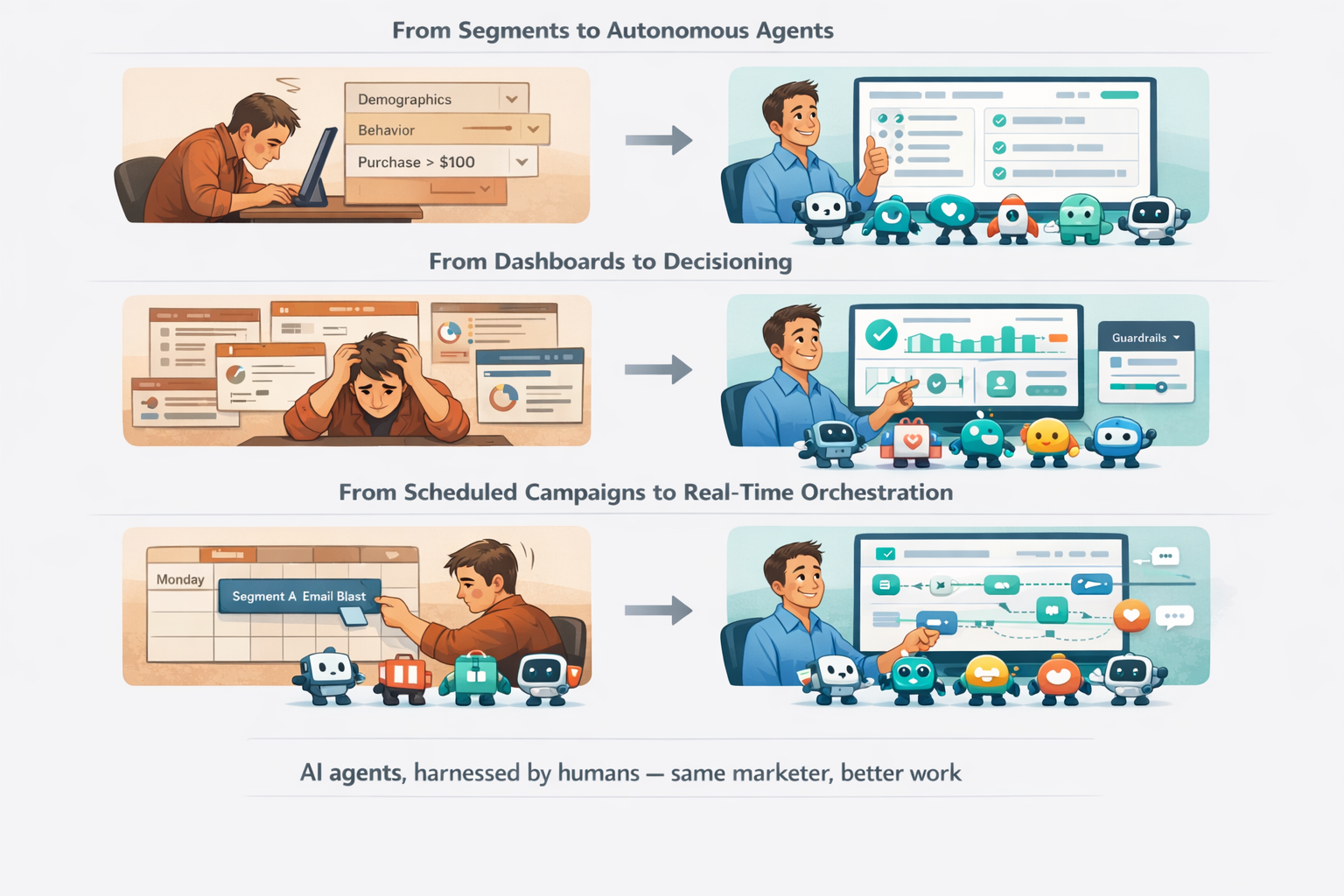
The convergence of CDPs and AI isn't a feature upgrade — it's an architectural shift. Here's what's changing:
From segments to autonomous agents
Traditional CDPs let marketers build segments. AI-native CDPs let autonomous agents discover segments, test messaging, and optimize in real time — without a human defining rules. The marketer sets the objective and guardrails; the agent does the rest.
From dashboards to decisioning
The old CDP workflow: pull a report → analyze → decide → act. The 2026 workflow: the CDP's AI decisioning layer evaluates every customer interaction in real time and selects the optimal action automatically. Dashboards still exist — but for oversight, not operation.
From scheduled campaigns to real-time orchestration
Batch-and-blast is over. A CDP with real-time streaming and AI marketing automation continuously adjusts every touchpoint — email, web, mobile, ads — based on what each customer is doing right now, not what a segment did last week.
Real-World Case Study: Subaru
Car buyers have long, complex customer journeys — making unified data and intelligent activation critical. But Subaru's data was scattered across more than a dozen siloed sources.
As Subaru's chief engineer of Digital Innovation, Ogawa Hideki, shared: "Unfortunately, the data we needed was scattered across more than a dozen sources. Our marketing department managed website logs, the sales organization stored purchase history, and customer support maintained service data."
Subaru turned to Treasure Data to unify billions of records into a single CDP — then used AI-powered segmentation and activation to target shoppers with relevant messaging at the right moment.
The results:
- 350% increase in ad click-through rates
- 250% increase in conversion rate for high-quality customer segments
- $1 million increase in revenue per 1% increase in conversion rate
- 38% less cost per acquisition
- 14% increase in closing rate
Omura Toshiyuki, Subaru's manager of Digital Innovation: "We are a small car company with a global brand. It's important for us to understand why our customers choose Subaru so that we can continue to meet and exceed their expectations. Treasure Data makes that understanding possible for us."
Explore the CDP Stack
A customer data platform is the foundation. Here's how each layer of the modern stack connects:
- AI Marketing — The 3 waves reshaping how teams plan, execute, and measure
- Agentic Marketing — AI agents that plan, execute, and optimize campaigns autonomously
- AI Personalization — The 3-layer framework that delivers 1:1 at scale
- AI Decisioning — Real-time, autonomous next-best-action for every customer
- AI Customer Segmentation — Finding patterns humans miss across 500+ attributes
- CDP vs CRM — When you need which
- CDP vs DMP — First-party data vs anonymous audiences
- CDP vs MDM — A side-by-side comparison
- CDP vs Data Warehouse — Activating data that's being stored
Customer Data Platform: Frequently Asked Questions
Ready to see what a CDP can do for your team? Request a custom demo to see Treasure Data in action — or keep reading for answers to the most common questions.
What is a customer data platform (CDP)?
A customer data platform is a unified customer database that collects data from every channel, resolves identities, and makes complete customer profiles accessible to marketing, sales, service teams — and in 2026, to AI agents that autonomously personalize every customer interaction.
How is a CDP different from a CRM or DMP?
A CRM manages direct sales interactions with known contacts. A DMP stores anonymous, third-party data for ad targeting. A CDP unifies all data types — first, second, and third-party, known and anonymous — into persistent customer profiles that both humans and AI agents can activate across every channel.
Why is the CDP definition changing in 2026?
Because the primary consumer of customer data is shifting from humans to AI agents. When autonomous marketing agents need to make millions of real-time decisions, the CDP must provide programmatic API and CLI access, real-time data streaming, and governance at machine speed — capabilities the original CDP definition never required.
How does AI change what a CDP does?
AI transforms every layer of the CDP: identity resolution becomes ML-powered, segmentation becomes autonomous discovery, personalization becomes real-time 1:1, and campaign execution becomes agent-driven. The CDP's role expands from a data store humans query to an intelligence layer agents act on.
What results do companies see from a CDP?
Leading enterprises report significant outcomes: Subaru achieved a 350% increase in click-through rates and 250% higher conversion rates. Anheuser-Busch InBev unified 2,000 data sources and 90 million customer records. A global gaming company saved $15 million in ad spend through better targeting.