
Will AI replace marketers? No — but it will replace marketers who don't use AI.
The shift isn't from human to machine. It's from manual execution to strategic orchestration. AI handles scale and speed; humans provide creativity, empathy, and brand judgment.
This guide covers how AI marketing actually works — from the data foundation it requires, to the three waves reshaping the field, to why human warmth and creativity remain the ultimate competitive advantage.
What Is AI Marketing?
AI marketing is the use of artificial intelligence — including machine learning, natural language processing, and autonomous agents — to analyze customer data, predict behavior, and execute marketing actions at scale.
If you're asking "what is AI in marketing?" the simplest answer is: AI makes marketing faster, more personalized, and more measurable — but only when it's built on the right data. According to McKinsey, generative AI alone could add $4.4 trillion to the global economy annually, with marketing and sales among the highest-impact functions. And a 2024 IBM study found that 72% of organizations have adopted AI across at least one business function — with marketing consistently ranking among the top three.
That said, the spectrum is wide. At one end, AI helps a marketer write subject lines faster. At the other, AI agents autonomously plan, execute, and optimize entire campaigns without human intervention. Understanding where you are on that spectrum — and where you're headed — matters more than picking the right tool.
Three Types of AI in Marketing
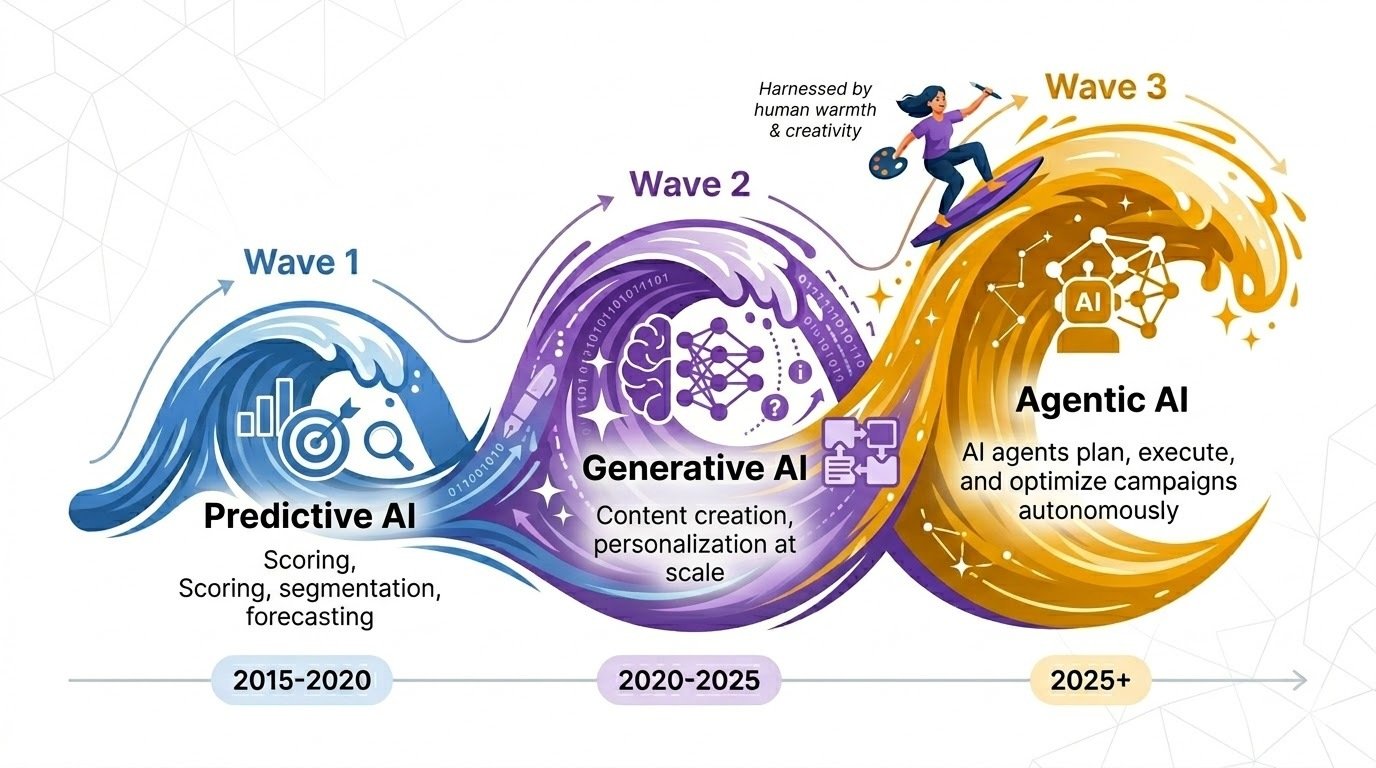
Predictive AI analyzes historical data to forecast what customers will do next — who's likely to churn, which leads will convert, what product someone will buy. This is the most mature form of AI in marketing and the foundation for segmentation and scoring models.
Generative AI creates new content — email copy, ad creative, product descriptions, images — based on prompts and training data. It dramatically accelerates content production but requires human oversight to maintain brand voice and accuracy.
Agentic AI goes further. Rather than predicting or generating, agentic AI systems autonomously plan and execute multi-step marketing workflows. An AI agent might observe a customer's behavior, decide the best next action, select the channel, compose the message, and send it — all without a human in the loop. This is the frontier of agentic marketing.
These three aren't alternatives — they're an evolution. Most organizations use all three, with predictive AI informing generative AI, and both feeding into agentic workflows as they mature.
How AI Marketing Works — The Data Foundation
Every AI marketing article talks about algorithms. Few talk about what those algorithms actually need to work: unified, real-time customer data.
AI models are only as good as the data they ingest. A churn prediction model trained on CRM data alone misses website behavior signals. A personalization engine without real-time data serves yesterday's recommendations. A generative AI tool without customer context produces generic copy.
Effective AI marketing operates in three layers:
- Data unification — collecting and stitching customer data from every source (web, mobile, email, POS, CRM, support) into a single profile
- Intelligence — applying ML models, predictions, and decisioning on top of that unified data
- Action — executing personalized messages, offers, and experiences across channels in real time
Most organizations get stuck at layer one. Data lives in silos — the email platform has email engagement data, the ad platform has impression data, the CRM has sales data — and no system has the complete picture. AI applied to incomplete data produces incomplete results.
The Role of Customer Data Platforms in AI Marketing
This is where a customer data platform (CDP) becomes essential. A CDP collects first-party data from every touchpoint, resolves customer identity across devices and channels, and builds unified profiles that AI can actually use.
Without a CDP, AI marketing is a collection of point solutions optimizing in isolation. With one, AI operates on a complete customer view — and the results compound. Segmentation gets more precise. Predictions get more accurate. Personalization gets more relevant.
The architecture of the CDP matters too. AI agents that need to make real-time decisions require real-time data access — sub-second profile lookups, not batch exports. This is why the shift from traditional data warehouses to platforms built for real-time activation is accelerating.
Read More: What Is a CDP? A Complete Guide for Customer Data Platforms
AI Marketing Use Cases
AI touches nearly every marketing function. But the impact of each use case depends on the data foundation underneath it. Here are the most common applications — and what each one requires to work well.
Audience Segmentation
Traditional segmentation relies on rules: customers who bought in the last 30 days, visitors who viewed a product page three times. AI-driven segmentation finds patterns humans can't see — clusters of behavior, micro-segments that respond differently to different messages, and segments that shift in real time as behavior changes.
Data requirement: Unified behavioral + transactional + demographic data. Siloed data means siloed segments.
Read More: AI Customer Segmentation: Nobody Knows Which Field Is Right
Personalization
AI personalization spans website content, email, ads, product recommendations, and in-app experiences. The most advanced implementations personalize in real time — adapting what a customer sees based on what they did seconds ago, not days ago.
Data requirement: Real-time unified profiles. Batch-synced data means yesterday's personalization.
Predictive Analytics
Churn prediction, customer lifetime value scoring, purchase propensity, next-product-to-buy — predictive models turn historical patterns into forward-looking action. Marketing teams use these scores to prioritize spend, trigger retention campaigns, and allocate budgets to high-value segments.
Data requirement: Deep historical data across channels. The more touchpoints in the model, the more accurate the prediction.
Content Generation
Generative AI accelerates the creation of email copy, ad headlines, social posts, product descriptions, and landing page variations. Teams that once spent days producing campaign assets can now generate dozens of variants in minutes — then let AI test and optimize them.
Data requirement: Brand guidelines, tone-of-voice documentation, and customer context. Without context, generative AI produces generic content that sounds like everyone else.
Campaign Optimization
AI optimizes send times, channel selection, budget allocation, bid strategies, and creative rotation. Rather than A/B testing two variants, AI can test hundreds simultaneously and converge on winners faster than any human analyst.
Data requirement: Cross-channel performance data feeding back into the optimization model. If email results don't inform ad spend decisions, the optimization is partial.
Customer Journey Orchestration
The most sophisticated use case: AI that manages the entire customer journey across channels, deciding what to say, when, and where — adapting in real time as the customer's behavior changes. This is where AI decisioning comes in, replacing rule-based journey builders with autonomous systems that learn from every interaction.
Data requirement: Complete, real-time unified profiles with a closed feedback loop — meaning the outcome of each action feeds back into the model immediately, not after a nightly batch job.
Lead Scoring and Qualification
For B2B organizations, AI transforms lead scoring from static point systems to dynamic models that learn which signals actually predict conversion. Rather than assigning arbitrary points to job titles and page views, AI identifies the behavioral patterns that precede closed deals — and continuously updates those patterns as the market shifts.
Data requirement: Unified CRM + marketing + product usage data. The model needs to see the full journey from first touch to closed deal.
Ad Targeting and Spend Optimization
AI-powered ad platforms optimize bidding, audience targeting, creative selection, and budget allocation across channels in real time. The most advanced implementations use first-party data from CDPs to build custom audiences and lookalike models that outperform third-party data segments — especially as cookie-based targeting declines.
Data requirement: First-party customer data synced to ad platforms, with conversion data flowing back to close the measurement loop. According to Gartner, organizations that invest in first-party data for AI-driven advertising see 20-30% improvement in ROAS compared to those relying on third-party segments alone.
The Three Waves of AI Marketing: From Automation to Autonomy
AI marketing is not a single technology. It's a progression — and knowing which wave you're in helps you invest in the right capabilities.
| Wave 1: Automation (2015–2020) |
Wave 2: Intelligence (2020–2025) |
Wave 3: Autonomy (2025+) |
|
|---|---|---|---|
| What AI does | Triggers, rules, A/B tests | Predicts, recommends, generates | Plans, decides, executes, learns |
| Human role | Designs every workflow | Approves AI suggestions | Sets goals and guardrails |
| Data need | Structured, siloed OK | Unified profiles | Real-time, closed feedback loop |
| Example | "If cart abandoned, send email in 2 hours" | "This customer has a 73% churn risk — recommend a retention offer" | "Agent identifies at-risk customer, selects best channel and message, sends it, measures result, adjusts approach for the next customer" |
Most companies today operate in Wave 2 — using predictive models and generative AI to inform human decisions. The shift to Wave 3 is happening now, driven by advances in AI agent platforms and the growing maturity of AI decisioning systems.
Read More: AI Marketing Automation: Why "Automation" Never Automated Anything
The critical enabler for Wave 3 is the closed feedback loop. When an AI agent sends a message, the outcome (opened, clicked, converted, ignored) must feed back into the model immediately — not after a nightly ETL job. This is what separates autonomous AI marketing from traditional automation wearing an AI label. If the loop is open — if outcome data takes hours or days to return — the agent can't learn fast enough to matter.
AI Marketing, Harnessed by Human Warmth and Creativity
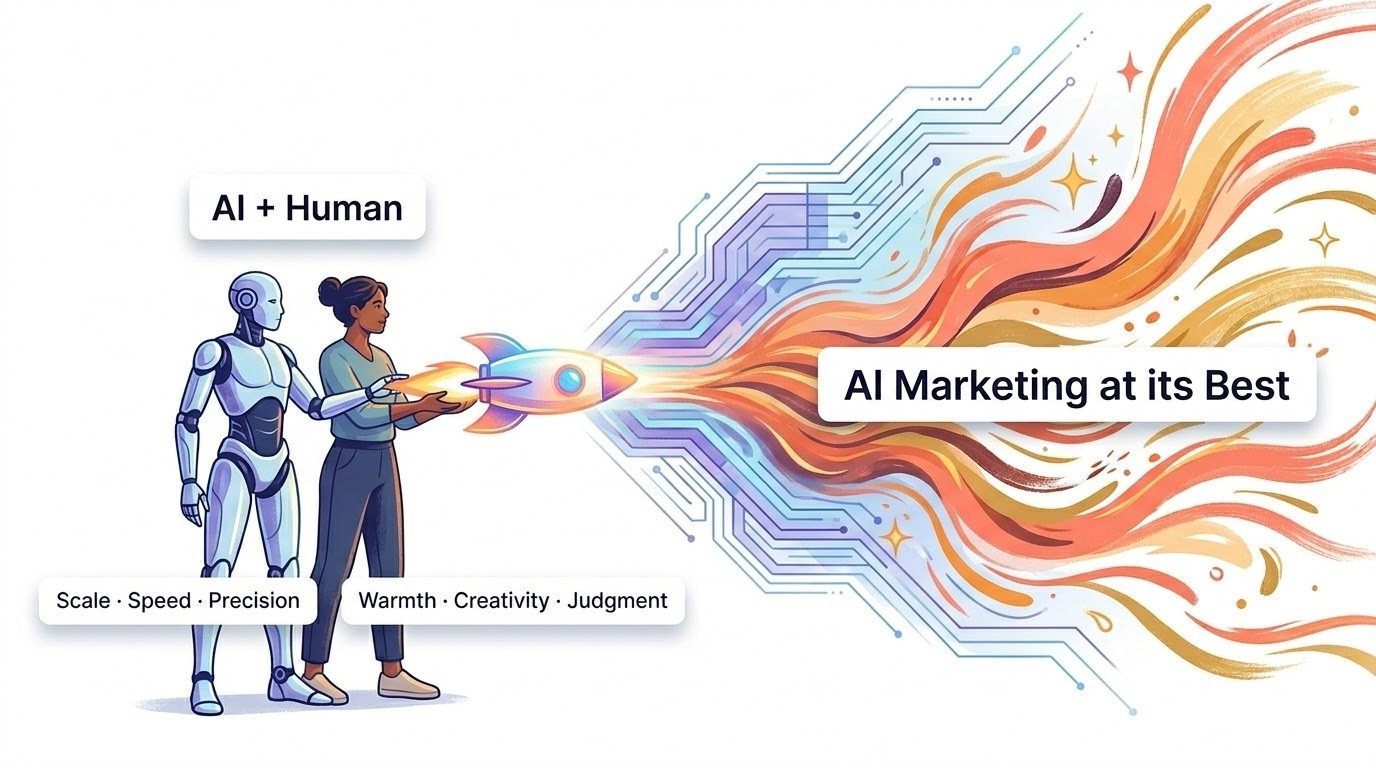
Here's what most AI marketing guides won't tell you: the technology is the easy part. The hard part is making sure AI-powered marketing still feels human.
AI can generate a thousand email variants in seconds. It can optimize send times for every individual customer. It can allocate budget across channels with mathematical precision. What it cannot do is feel what it's like to be your customer. It cannot tell a story that makes someone laugh, or choose the word that turns a tagline into a cultural moment, or know that this particular message — while technically optimal — would feel tone-deaf given what's happening in the world right now.
The best AI marketing doesn't replace human creativity. It amplifies it.
| What AI does | What humans do | |
|---|---|---|
| Scale | Generates 1,000 message variants | Decides which ones are "on brand" |
| Judgment | Selects the optimal channel and timing | Asks "is this appropriate right now?" |
| Emotion | Analyzes sentiment at scale | Creates the emotion in the first place |
| Pattern | Finds what worked before | Imagines what's never been tried |
This is why guardrails matter — not as limitations, but as the mechanism through which human judgment scales alongside AI. Brand voice guidelines become parameters the AI must respect. Compliance rules become hard constraints in the decisioning engine. Ethical boundaries — which segments can receive which messages, which data can inform which decisions — become encoded in the platform, not left to individual campaign managers to remember.
In regulated industries like financial services and healthcare, these guardrails aren't optional — they're legal requirements. But even in less regulated sectors, brands that let AI run unchecked risk the kind of tone-deaf, context-blind messaging that erodes trust.
The organizations getting AI marketing right are the ones that treat the human role not as a bottleneck to be automated away, but as the source of warmth, creativity, and judgment that makes marketing worth paying attention to. AI handles the how — the scale, the speed, the optimization. Humans define the why — the brand story, the creative vision, the ethical lines.
When that balance is right, AI marketing doesn't feel like AI marketing. It just feels like a brand that knows you.
AI Marketing Best Practices
1. Start with Data, Not Tools
The most common mistake in AI marketing: buying a shiny AI tool before cleaning up the data it needs to work. Invest in data unification first. Map every customer data source — CRM, email platform, website analytics, mobile app, POS, support tickets — and build a plan to connect them. The AI tools will deliver 10x more value when they operate on complete data.
2. Unify Before You Automate
Automating on top of fragmented data just creates faster mistakes. Before launching AI-powered campaigns, ensure your customer profiles are unified, deduplicated, and enriched. A customer data platform makes this possible at scale.
3. Close the Feedback Loop
Every AI-powered campaign should feed its results back into the model that created it. Did the email get opened? Did the recommendation convert? Did the ad drive a store visit? The faster this feedback loop runs, the faster AI learns — and the wider the gap between you and competitors running on batch data.
4. Let AI Scale, Let Humans Steer
Define clear guardrails: brand voice parameters, compliance constraints, ethical boundaries, budget limits. Then let AI operate freely within those boundaries. Review outputs regularly, but resist the urge to manually approve every action — that defeats the purpose of autonomous marketing.
5. Measure What Matters
AI makes it easy to optimize for vanity metrics — open rates, click rates, impressions. Focus instead on business outcomes: revenue per customer, customer lifetime value, incremental lift, and true attribution. The best AI marketing platforms connect campaign actions to downstream revenue, not just engagement.
How to Build an AI Marketing Stack
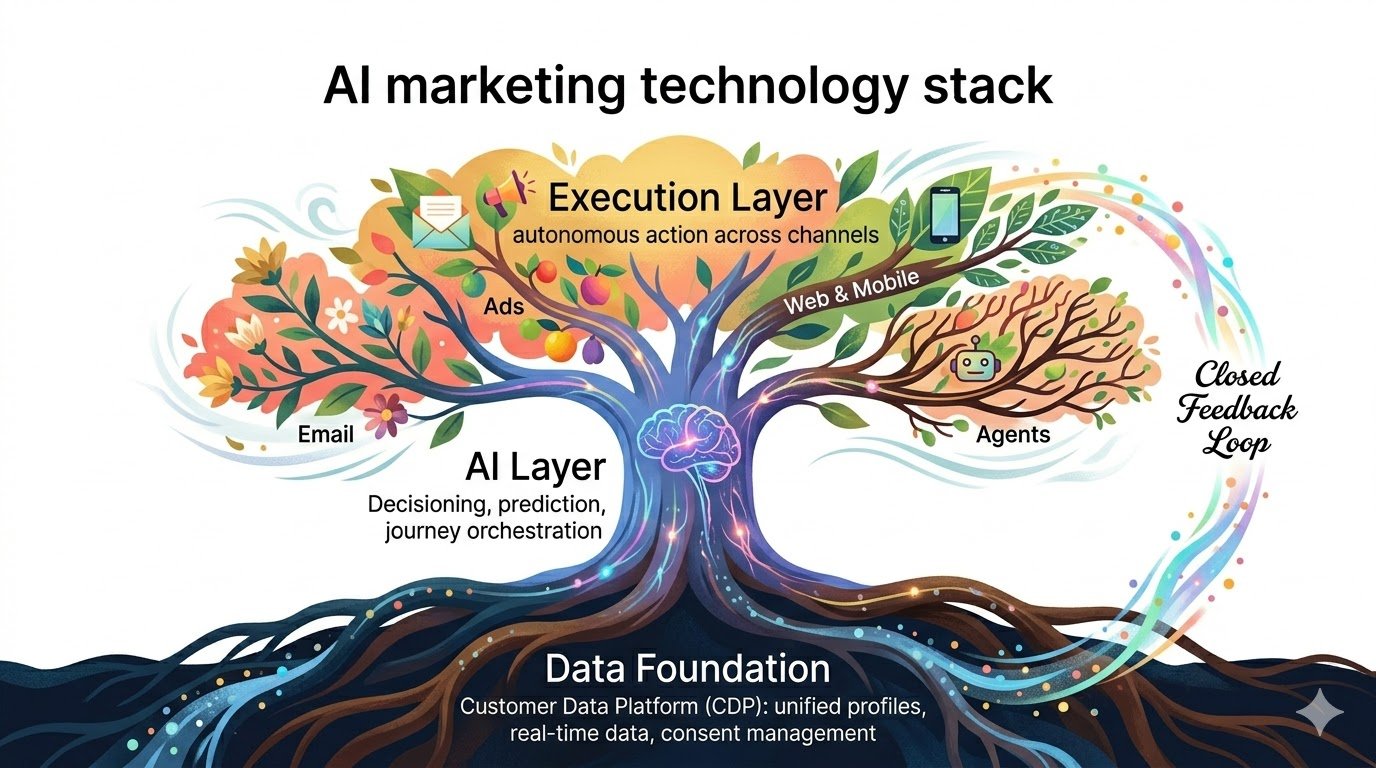
You don't need to rip and replace your entire martech stack. But you do need to build on the right foundation.
Step 1: Unify Your Customer Data
Start with a customer data platform that ingests data from every source, resolves identity across channels, and builds unified profiles. This is the non-negotiable foundation. Without it, every subsequent layer underperforms.
Step 2: Define Your First AI Use Cases
Pick 2-3 high-impact use cases to start — typically audience segmentation, predictive scoring, or personalization. Don't try to boil the ocean. Prove value with one use case before expanding.
Step 3: Choose Your Architecture
The key decision: do you need real-time decisioning and autonomous agents, or is batch-based activation sufficient? If your use cases require reacting to customer behavior in the moment — abandoned carts, browsing patterns, live interactions — you need a platform with a real-time profile store and a closed feedback loop. If your use cases are primarily batch (weekly audience syncs, monthly reporting), a warehouse-based approach may suffice.
Step 4: Pilot with a Proof of Concept
Run a proof of concept with real customer data — not a demo environment. Test data ingestion speed, identity resolution accuracy, segment creation workflows, and the time from insight to action. This reveals more about a platform's true capabilities than any sales presentation.
Step 5: Scale with Autonomous Agents
Once your data foundation is solid and your first use cases are delivering results, introduce agentic marketing capabilities. Start with a single use case — like next-best-action for a specific segment — and expand as the AI proves itself. The goal is a system that continuously learns and improves, with humans setting the strategy and guardrails.
The Future of AI Marketing
AI in marketing is evolving faster than most organizations can adopt it. But the direction is clear. Three shifts will define the next era:
AI agents become the primary CDP users. Today, marketers log into platforms and build segments. Tomorrow, AI agents will be the primary consumers of customer data — querying profiles, making decisions, and executing actions at machine speed. The platforms that win will be the ones designed for agent-to-platform interaction, not just human-to-platform. This is already happening: according to Salesforce, 68% of customers say advances in AI make it more important for companies to be trustworthy — signaling that as AI scales, so must the governance around it.
First-party data becomes the only sustainable AI advantage. With third-party cookies disappearing and privacy regulations tightening globally (GDPR, CCPA, and newer frameworks in Asia and Latin America), the brands with the richest first-party data will have the best AI. Data collection, consent management, and customer trust aren't just compliance requirements — they're competitive moats. Every company has access to the same foundation models. Not every company has a unified, consented, first-party data asset to feed them.
The feedback loop becomes the competitive differentiator. Two companies can use the same AI models. But the one that closes the feedback loop faster — learning from every interaction in real time rather than in daily batches — will outperform. Speed of learning, not sophistication of models, will separate winners from the rest. This is why architecture decisions made today — real-time profile stores vs. batch warehouse syncs, closed-loop platforms vs. stitched-together point solutions — will have outsized impact on AI marketing performance for years to come.
The future of AI marketing isn't about more AI. It's about better data, faster feedback, and the human judgment to use both wisely.
Getting Started
AI marketing is not about which chatbot you use or how many tools are in your stack. It's about whether your customer data is unified, your feedback loops are closed, and your team knows where AI should lead and where humans must steer.
The companies that get this right don't just run better campaigns. They build a compounding advantage — where every interaction makes the next one smarter, every data point deepens the customer relationship, and AI amplifies human creativity instead of replacing it.
Start with the data. Close the loop. Let humans be human.
Read More: Agentic Marketing: How AI Agents Transform Campaigns
Read More: AI Decisioning: What It Is, How It Works, and Why It Matters
Read More: AI Agent Platform: The Complete Guide to Building AI Agents
Frequently Asked Questions
What is AI marketing?
AI marketing is the use of machine learning, predictive analytics, and autonomous agents to personalize, optimize, and execute marketing campaigns. It spans three waves: predictive AI for forecasting, generative AI for content creation, and agentic AI for autonomous campaign execution.
Will AI replace marketers?
No — but it will replace marketers who don't use AI. The shift isn't from human to machine. It's from manual execution to strategic orchestration. AI handles scale and speed; humans provide creativity, empathy, and brand judgment.
How can AI be used for marketing?
AI applies to nearly every marketing function: predictive analytics identifies high-value prospects before they convert, machine learning optimizes ad spend and channel mix in real time, generative AI produces individualized content at scale, and autonomous agents orchestrate entire campaigns — selecting audiences, timing, channels, and creative for each customer simultaneously. The shift is from marketers configuring tools to marketers setting objectives and letting AI execute.
What is the ROI of AI marketing?
ROI depends on implementation maturity. McKinsey reports that companies excelling at AI-driven personalization generate 40% more revenue from those activities than average players. More broadly, enterprises using AI across their marketing stack see 10-30% improvements in conversion rates and 15-25% reductions in customer acquisition cost. The key variable is data quality — AI marketing built on unified customer profiles consistently outperforms AI running on fragmented, siloed data.