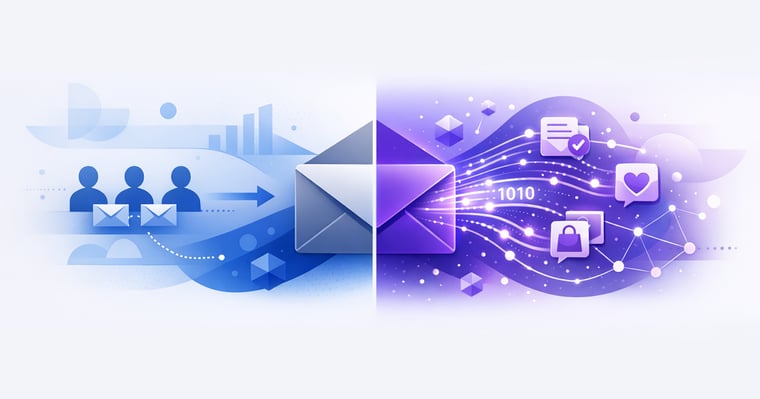
Your email marketing platform says it's personalizing. It's not.
It's inserting a first name. Picking a send time. Maybe choosing between two subject lines. Then delivering the same campaign to 50,000 people who happen to share a demographic checkbox.
That's not AI email marketing. That's mail merge with better timing — for most of your subscribers, at least.
Real AI email marketing doesn't start with the email. It starts with the data underneath it — the complete, unified profile of each individual customer. What they browsed yesterday. What they bought last quarter. That they called support this morning. That they opened the last three emails but clicked nothing. That they always convert on mobile, on Thursdays, with discount offers over $20.
When an AI has access to all of that, it doesn't send a "personalized" email. It sends the right email — with the right content, the right offer, through the right channel, at the right moment — to each individual. Not to a segment. To a person.
Most email platforms can't do this because they only see email data. They're optimizing inside a silo. This guide shows what changes when you break out of it — and why the shift from email platform AI to CDP-powered AI is the difference between incrementally better campaigns and fundamentally different results.
What Is AI Email Marketing?
AI email marketing is the use of artificial intelligence to create, target, deliver, and optimize email communications based on individual customer data. It applies machine learning, predictive analytics, and generative AI to move beyond segment-based campaigns toward true 1:1 email experiences.
In practice, AI email marketing operates on a spectrum — from basic optimizations that most email platforms already offer, to fully autonomous systems that compose, target, and learn from every individual interaction.
The Spectrum of AI in Email
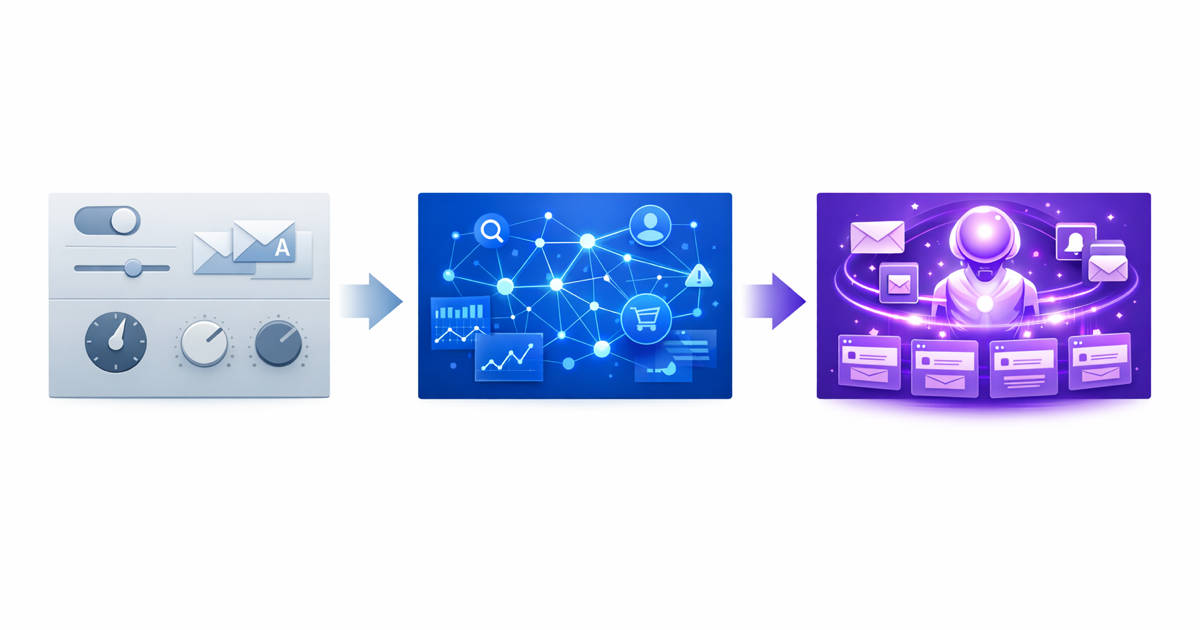
Level 1: Optimization layer (what most Email Service Provider call "AI")
- Send-time optimization
- Subject line A/B testing
- Basic open/click prediction
Level 2: Intelligence layer (requires more data)
- Predictive content selection
- Behavioral trigger sequencing
- Churn risk scoring per subscriber
Level 3: Autonomous layer (requires unified data + generative AI)
- Individualized copy and creative per recipient
- Cross-channel aware email decisioning
- Self-optimizing campaigns that learn from every send
Most email platforms operate at Level 1. Some reach Level 2. Level 3 requires something most ESPs (Email Service Providers) don't have: access to the full customer profile beyond email.
Why Most AI Email Marketing Underperforms
The problem isn't the AI. It's the data the AI can see.
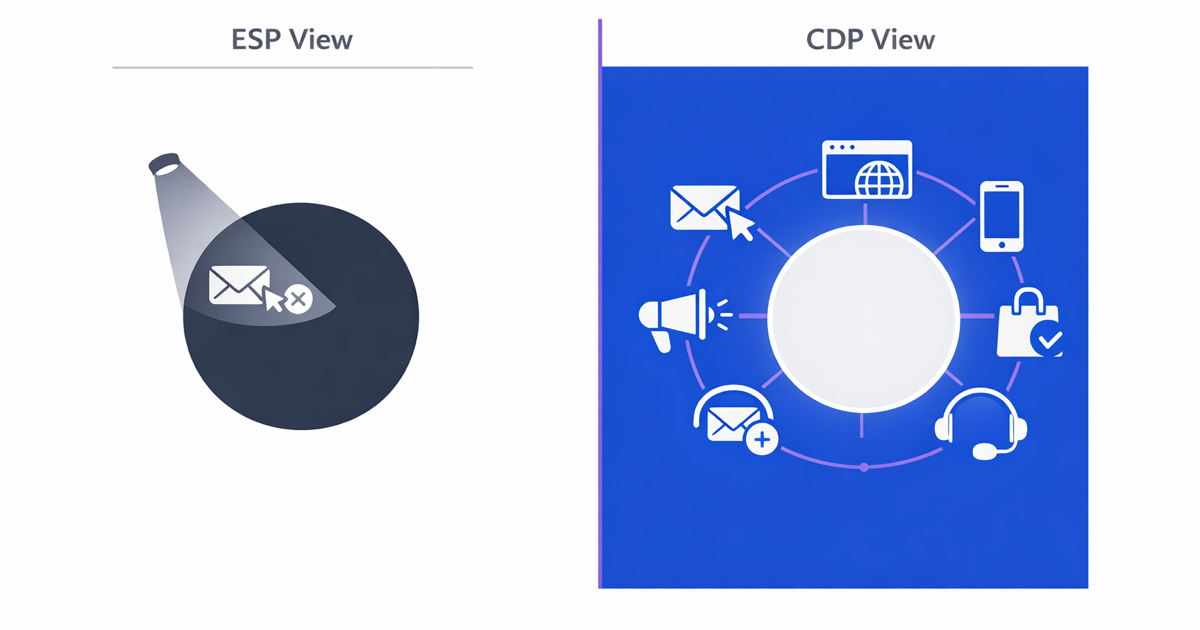
The ESP (Email Service Provider) Data Ceiling
Your email platform knows:
- Opens, clicks, unsubscribes
- Email engagement history
- Basic profile fields (name, signup date, preferences)
Your email platform does not know:
- What the customer browsed on your site 10 minutes ago
- That they abandoned a cart on mobile yesterday
- That they called support twice this week
- Their purchase history across all channels
- Their predicted lifetime value
- Their real-time segment membership
When AI optimizes based only on email data, it's making decisions with maybe 5-10% of the customer picture. The result is "personalization" that feels generic — because it is. According to Deloitte, companies that leverage full customer data for personalization reduce cost per acquisition by up to 50% and increase marketing revenue by 5-15%.
The Segment Illusion
Most email marketers think they're personalizing because they're segmenting. But segmentation is not personalization — even AI-powered segmentation is only the starting point, not the destination.
Sending different emails to "high-value customers who haven't purchased in 30 days" versus "new customers in their first week" is better than blasting everyone. But within each segment, every person gets the same email. A segment of 50,000 is still a mass send.
True AI email personalization evaluates each individual and composes a unique combination of content, offer, timing, and channel. That requires data — far more data than any email platform holds on its own.
What Changes With Unified Data
When AI email marketing runs on a customer data platform that unifies every touchpoint — web, app, email, support, purchase, ad interaction — the calculus changes completely:
- A customer who just browsed winter coats gets an email featuring the exact coat they viewed, with a personalized incentive based on their price sensitivity.
- A customer who called support with a complaint gets suppressed from promotional sends for 48 hours — because the AI knows about the call, not just the email history.
- A customer who always converts on mobile with free shipping offers gets that exact combination, while a desktop buyer who responds to percentage discounts gets something entirely different.
The email looks different for every person because the AI sees every person differently.
5 Ways CDP-Powered AI Transforms Email Marketing
1. Individualized Content Generation
Most email teams create 3-5 variants per campaign. Generative AI connected to unified profiles can produce unique content for each recipient — tailored subject lines, body copy, images, and CTAs based on individual preferences, behavior, and predicted intent.
This isn't template-based dynamic content with merge tags. It's fully composed, contextually relevant messaging that reflects who each person actually is.
The math: 3 variants for 100,000 subscribers = 33,333 people per variant. Individual generation = 100,000 unique emails. The engagement difference is not incremental — enterprises using CDP-powered individualized email report 30-50% higher click-through rates and 15-25% higher revenue per email compared to segment-based approaches (Forrester, 2025).
2. Cross-Channel Aware Decisioning
Should this customer even receive an email right now? Maybe they'd respond better to a push notification. Maybe they just saw a retargeting ad with the same offer. Maybe they're mid-conversation with a support agent.
Email platforms can't answer these questions because they only see email. CDP-powered AI evaluates the customer's entire journey and decides whether email is the right channel, right now, for this person. Sometimes the smartest email is the one you don't send.
This is where AI decisioning meets email execution — the AI optimizes not just the email, but whether to send it at all.
3. Predictive Lifecycle Orchestration
Static email journeys (welcome → nurture → convert → retain) assume everyone follows the same path. They don't.
AI analyzes each subscriber's behavioral signals and autonomously adjusts their journey in real time. A new subscriber showing high purchase intent skips the nurture sequence and goes straight to a product recommendation. A loyal customer showing early churn signals gets routed to a retention-focused flow.
The journey isn't a fixed track — it's a living, individualized path that adapts with every interaction.
4. Send-Time Optimization That Actually Works
Every ESP (Email Service Profider) offers send-time optimization. Most of them analyze email-only data — when people open, when they click.
CDP-powered send-time optimization factors in:
- When the customer is actually active across all channels (not just email)
- Their real-time context (traveling? at work? browsing your site right now?)
- Competitive timing (did they just receive 3 other brand emails?)
- Channel preference signals (maybe this person should get an SMS instead)
The difference: ESP (Email Service Profider) send-time optimization picks the best hour. CDP-powered optimization picks the best moment, channel, and message simultaneously.
5. Automated Suppression and Compliance
Bad email experiences damage brands. AI with full customer context automatically suppresses sends when:
- A customer just filed a support ticket
- They've received 3+ brand touches in 24 hours
- Their consent preferences changed on another channel
- Their engagement pattern suggests email fatigue
This isn't a manual suppression list. It's real-time, per-individual evaluation that protects customer relationships and regulatory compliance simultaneously.
AI Email Marketing vs. Traditional Email Marketing
| Dimension | Traditional Email | AI Email (ESP only) | AI Email (CDP-powered) |
|---|---|---|---|
| Data input | Email engagement only | Email + basic profile | Full cross-channel profile |
| Personalization | Segment-based | Segment + dynamic content | Individual-level |
| Content | Human-created variants | AI-suggested subject lines | AI-generated per recipient |
| Timing | Scheduled or basic STO | Email-based STO | Cross-channel moment optimization |
| Journey | Fixed sequences | Trigger-based branches | Autonomous, adaptive paths |
| Channel awareness | Email only | Email only | Omnichannel orchestration |
| Suppression | Manual lists | Rule-based | Real-time contextual |
What to Look For in an AI Email Marketing Stack
1. Unified Data Access
The AI must draw from more than email data. Look for native integration with a CDP or customer data infrastructure that feeds web, app, purchase, support, and ad data into the email decisioning engine.
2. Generative Content at Scale
Can the platform generate individualized copy and creative for each recipient — not just swap merge tags? Native generative AI, connected to customer profiles, is the difference between AI personalization and advanced mail merge.
3. Cross-Channel Orchestration
Email doesn't exist in isolation. The platform should coordinate email with other channels so the customer experience is coherent, not repetitive. If they saw the offer on your site, they shouldn't see it again in email.
4. Autonomous Journey Optimization
Static workflow builders are the past. Look for AI that autonomously routes individuals through journeys based on real-time signals — not marketer-configured if/then branches. This is where AI marketing automation evolves from rule execution to intelligent orchestration.
5. Explainability and Governance
When AI decides what to send to whom, you need to understand why. The platform should explain its decisions — critical for brand safety, regulatory compliance, and organizational trust. AI that runs campaigns, harnessed by human judgment and oversight.
Getting Started: From ESP AI to CDP-Powered AI
Phase 1: Audit Your Current "Personalization" (Week 1)
Ask: how many data points does our AI actually use per email? If the answer is fewer than 10 (name, segment, open history, etc.), you're at Level 1. Map the gap between what your ESP sees and what you know about your customers.
Phase 2: Connect Email to Unified Profiles (Weeks 2-4)
Integrate your ESP with a CDP. Feed web behavior, purchase history, support interactions, and app activity into the same profiles your email AI uses. The goal: every email decision draws from the full customer picture.
Phase 3: Pilot Individualized Campaigns (Weeks 4-8)
Start with one high-value email flow — cart abandonment or retention. Replace segment-based content with AI-generated individual content. A/B test against your current approach. Measure click-through rate, conversion, and revenue per email.
Phase 4: Expand to Autonomous Orchestration (Weeks 8+)
Once you've proven the lift, extend to full journey orchestration. Let the AI decide not just what to send, but when, where, and whether. Set objectives, define guardrails, and let the system optimize.
The Future of AI Email Marketing
1. Email becomes one expression of a unified conversation. The distinction between "email marketing" and "marketing" dissolves. AI marketing agents orchestrate customer experiences across every channel, and email is simply one output — chosen when it's the right channel for that person at that moment.
2. Every email becomes unique. Generative AI eliminates the concept of "email variants." Each recipient gets a fully composed, individually relevant message. The creative bottleneck that limits most email programs disappears.
3. The metric shifts from open rate to lifetime value. When AI optimizes for long-term customer value rather than short-term engagement metrics, email strategy fundamentally changes. Sometimes the AI will send fewer emails — because it learns that restraint drives more revenue than frequency. McKinsey's research on personalization at scale confirms this: brands that optimize for customer lifetime value over campaign-level metrics see 20-30% higher marketing ROI and measurably lower unsubscribe rates.
Frequently Asked Questions
What is AI email marketing?
AI email marketing uses artificial intelligence to create, target, deliver, and optimize email communications based on customer data. It ranges from basic send-time optimization to fully autonomous systems that generate individualized content, select optimal channels, and learn from every interaction.
How is AI email marketing different from regular email marketing?
Traditional email marketing sends pre-built campaigns to segments on a schedule. AI email marketing analyzes individual customer data to personalize content, timing, and channel selection for each recipient — continuously learning and improving from every send.
Why do most AI email marketing efforts underperform?
Because most email platforms only access email engagement data — opens, clicks, and unsubscribes. AI needs the full customer profile (web behavior, purchases, support history, app activity) to personalize effectively. Without unified data, "AI personalization" is just better guessing.
What is the role of a CDP in AI email marketing?
A CDP creates unified customer profiles by merging data from every touchpoint. This gives AI email marketing access to the complete customer picture — not just email metrics — enabling true 1:1 personalization, cross-channel orchestration, and intelligent suppression.
How does generative AI change email marketing?
Generative AI produces unique copy, subject lines, and creative for each individual recipient based on their profile. Instead of creating 5 email variants for 100,000 subscribers, AI generates 100,000 unique emails — each contextually relevant to one person.
Should I replace my ESP with a CDP?
Not necessarily — but the gap between them is shrinking. Traditional CDPs unify data; traditional ESPs deliver email. Newer platforms like Treasure Data's Engagement AI Suite combine both: unified customer profiles, AI-powered decisioning, and email/mobile execution in a single stack — eliminating the integration gap where most "personalization" breaks down.
What metrics should I track for AI email marketing?
Move beyond open rates (unreliable post-Apple MPP) to click-through rate, revenue per email, conversion rate, customer lifetime value impact, and unsubscribe rate. Always measure against a holdout group to isolate AI's incremental impact.
Ready to see the difference between email-only AI and CDP-powered AI email marketing? Explore the Engagement AI Suite →