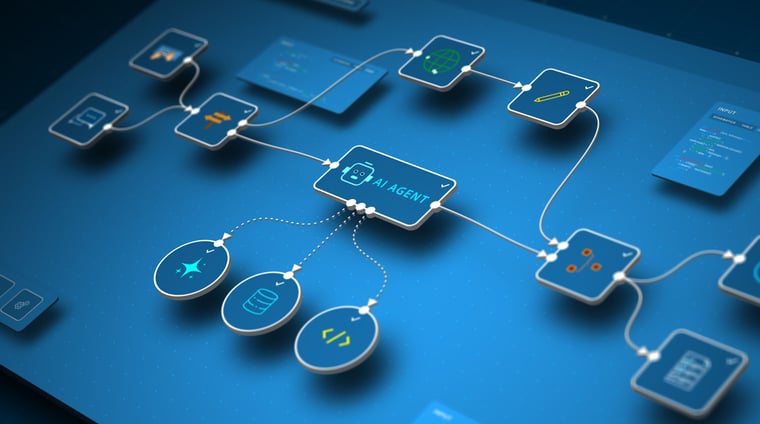
Marketing automation was supposed to automate marketing.
Instead, you spend Monday morning dragging boxes in a workflow builder. Cloning last month's campaign. Re-picking segments. Triple-checking suppression lists. Exporting a CSV to see what worked. Pasting it into a spreadsheet for the weekly standup.
This is not automation. This is manual work with a better UI.
These platforms automated the send — but left the strategy, the decisions, and the learning to you. That's like calling a car "self-driving" because it has cruise control.
Real AI marketing automation means the platform handles the thinking, not just the sending. That shift starts with one thing most platforms don't have: unified customer data.
What Is AI Marketing Automation?
AI marketing automation is the use of machine learning, predictive models, and autonomous agents to plan, execute, and optimize marketing campaigns with minimal manual input.
That definition sounds simple. The distinction from traditional marketing automation is not.
| Traditional Automation | AI-Powered Automation | Agentic Automation | |
|---|---|---|---|
| Logic | Rules: "If cart abandoned, send email in 24h" | Models: "Predict best time, channel, and offer per customer" | Agents: "Plan, execute, and optimize full campaign autonomously" |
| Human role | Build every workflow manually | Set goals, review recommendations | Set guardrails, approve strategy, focus on creative |
| Learning | None — same rules until you change them | Batch — retrains on historical data periodically | Continuous — closed feedback loop, learns from every interaction in real time |
| Data requirement | Basic: email, name, one trigger event | Moderate: behavioral history, purchase data | Full: unified customer profile with real-time updates |
Most platforms today sit between column one and column two. They call it "AI" because they added a subject line optimizer or a send-time predictor. But the architecture — rule-based workflows that a human must build, clone, and maintain — hasn't changed.
Agentic marketing is the third column. It requires a fundamentally different foundation.
Why AI-Powered Marketing Automation Still Underdelivers
Marketing automation is a $6.6 billion market. Yet the most common complaint from marketers is the same one they had before buying: campaigns still feel generic, and the tools still feel manual.
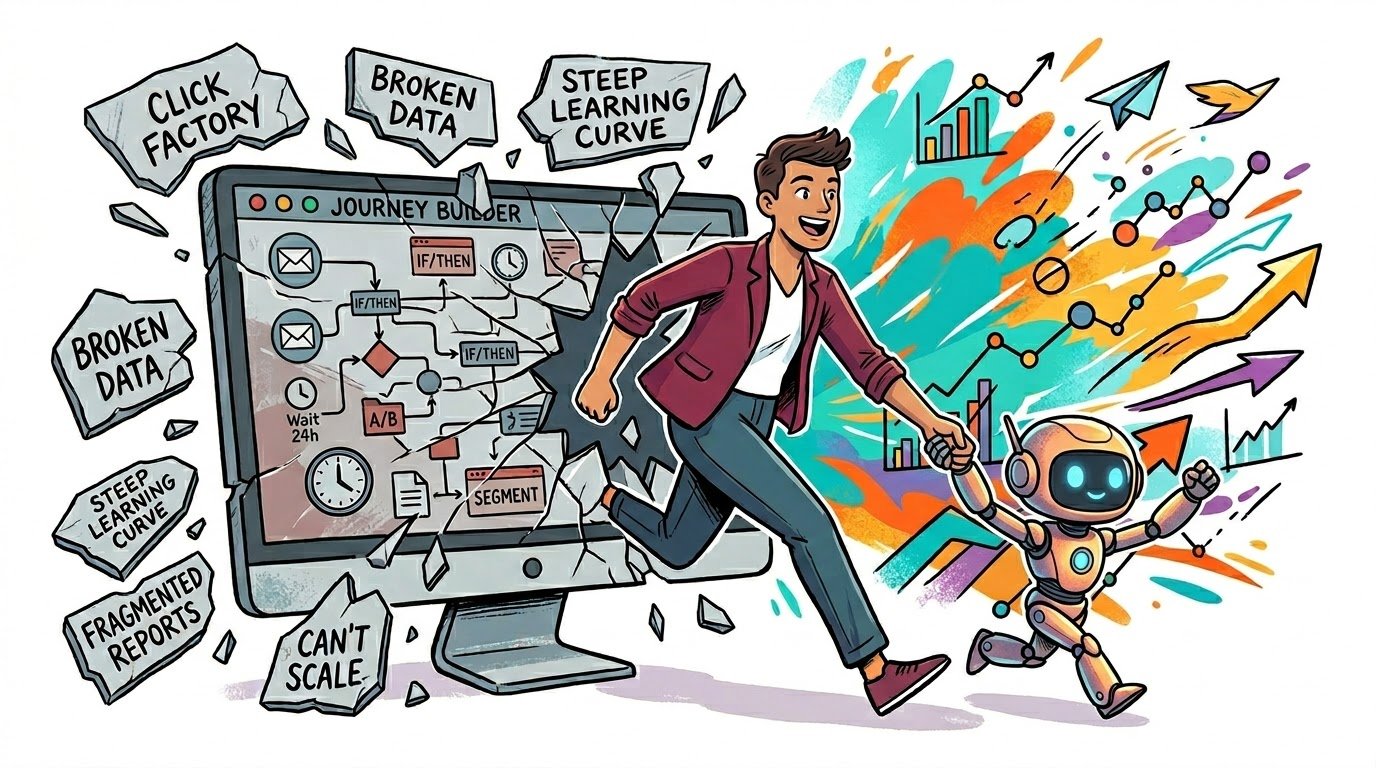
We analyzed hundreds of G2 reviews across the six most widely used marketing automation platforms — Salesforce Marketing Cloud, Adobe Campaign, Marketo, Braze, Iterable, and MoEngage — to understand what's actually going wrong. The pain points cluster into five patterns, and they all trace back to the same root cause.
1. The UI Is a Click Factory
The most universal complaint is also the most ironic: "marketing automation" platforms require enormous amounts of manual work.
"The user interface is often cumbersome and requires many clicks to accomplish simple tasks. The UI frequently loses context, such as collapsing folder structures upon page reloads."
— Salesforce Marketing Cloud review on G2
"It is extremely powerful, but can be slow, hard to navigate, and resource-intensive for teams that prioritize ease of use and quick execution."
— Salesforce Marketing Cloud review on G2
"Everything feels like it requires too many clicks. Copy campaigns, end up with duplicates that create unnecessary noise."
— Iterable review on G2
These platforms were built around visual workflow builders — drag a box, connect a branch, set a condition. That was innovative in 2012. In 2026, it means a marketer spends their day as a workflow administrator, not a strategist.
2. Data Integration Is Broken
Campaign platforms know what they sent. They don't know who the customer is.
"The data model and functions are still very limited. Restrictive limits on data in catalogues, nested filters. If you don't have strong data support, this is not the tool for you. Think of it as simply a sending tool."
— Braze review on G2
"The promised segmentation didn't work. Even Abandoned Basket failed consistently for 2 years. A huge disbenefit to our company — 2 wasted years and £500k of unnecessary cost."
— Adobe Campaign review on G2
"Data tracking and duplicity caused a high MTU, which resulted in an increased invoice amount."
— MoEngage review on G2
ESPs and campaign execution tools were never designed to unify customer data. That's a different job — and trying to force it creates broken integrations, duplicate records, and incomplete profiles.
3. Learning Curve Is a Cliff
Many marketing automation platforms require technical skills that most marketers don't have — and shouldn't need.
"The learning curve is steep, especially when working with AMPscript, SQL, and data extensions — marketers often need technical or developer support to fully use the platform."
— Salesforce Marketing Cloud review on G2
"I am having a really hard time understanding nuances about how to use certain features, even for simple tools like segmentation."
— Iterable review on G2
When the platform is complex, adoption stays low — which means the automation runs on the limited knowledge of the 1-2 people who actually understand it.
4. Reporting Is Fragmented
"Reporting and data is at times not easy to navigate and often requires multiple steps in order to access."
— Braze review on G2
"Some reporting workflows are not as intuitive as expected for day-to-day use."
— Salesforce Marketing Cloud review on G2
When data lives in different tools, reporting means exporting from each one and assembling the picture manually. This isn't a reporting problem — it's a data architecture problem.
5. The Platform Can't Scale With You
"Good for basic needs but couldn't catch up when we grew faster than MoEngage."
— MoEngage review on G2
"It's limited compared to an enterprise ESP, with a lot of features requiring third-party software providers."
— Iterable review on G2
The pattern: all five pain points trace back to one architectural reality. ESPs and campaign platforms are sending tools. They were not designed to unify customer data, run AI models, or close feedback loops. Asking them to do these things is asking a bicycle to be a car.
The Missing Foundation: Unified Customer Data
Every pain point above has the same root cause: the automation platform doesn't have a complete picture of the customer.
A customer data platform (CDP) solves this by creating a unified, real-time profile for every customer — combining behavioral, transactional, demographic, and consent data from every source.
When automation runs on unified profiles instead of fragmented tool-specific data:
| Without unified data | With unified data (CDP) |
|---|---|
| Email sent to customer who just purchased in-store | Real-time profile includes in-store purchase → auto-suppressed |
| Lead scored as cold (webinar attendance invisible to CRM) | All touchpoints unified → accurate lead score |
| Email + ad + SMS all fire at once | Cross-channel orchestration on one profile → coordinated cadence |
| Export CSVs from 4 tools, paste into spreadsheet | Single source of truth → real-time cross-channel attribution |
This is why AI marketing starts with data, not tools. The most sophisticated AI model in the world will underperform if it's reading from incomplete, stale, or conflicting customer records.
AI Marketing Automation Use Cases
When AI runs on unified data, these use cases go from theoretical to operational.
1. Email Send-Time and Content Optimization
AI determines the optimal send time, subject line, and content variant for each individual — not the average best time for a segment. This requires per-customer engagement history, which only exists in a unified profile. This is AI email marketing beyond the ESP data ceiling.
2. Predictive Audience Segmentation
Instead of manually defining segments by rules, AI identifies clusters of customers with similar behavioral patterns that predict future actions. The model retrains as new data flows in, so segments evolve with your audience.
3. Cross-Channel Journey Orchestration
An AI agent observes a customer's real-time behavior and coordinates the next touchpoint across email, push, SMS, web, and ads. If a customer ignores email but engages with push, the system adapts. No manual workflow builder. No branch-dragging.
4. Predictive Lead Scoring
AI scores leads based on behavioral patterns that correlate with conversion — not just form fills and page views. It identifies which combination of signals predicts pipeline, and updates scores in real time.
5. Dynamic Website Personalization
Real-time customer profiles enable per-visitor personalization: different hero images, CTAs, pricing, and content blocks based on who the visitor is and what they've done across all channels.
6. Ad Spend Optimization
AI connects first-party CDP data to ad platforms — creating suppression lists, lookalike audiences based on best customers, and bid adjustments based on predicted lifetime value rather than click-through rate.
7. Churn Prevention
Predictive models identify customers showing early disengagement signals — declining logins, reduced purchases, negative support interactions — and trigger retention campaigns before the customer decides to leave.
8. Autonomous Campaign Execution
The most advanced use case: an AI agent receives a goal, plans a multi-channel campaign, selects audiences, generates content variants, launches, monitors, and adjusts in real time. The marketer sets the goal and guardrails. The agent handles everything else.
Read More: AI Decisioning: What It Is, How It Works, and Why It Matters
From Rules to Agents: The Evolution of Marketing Automation
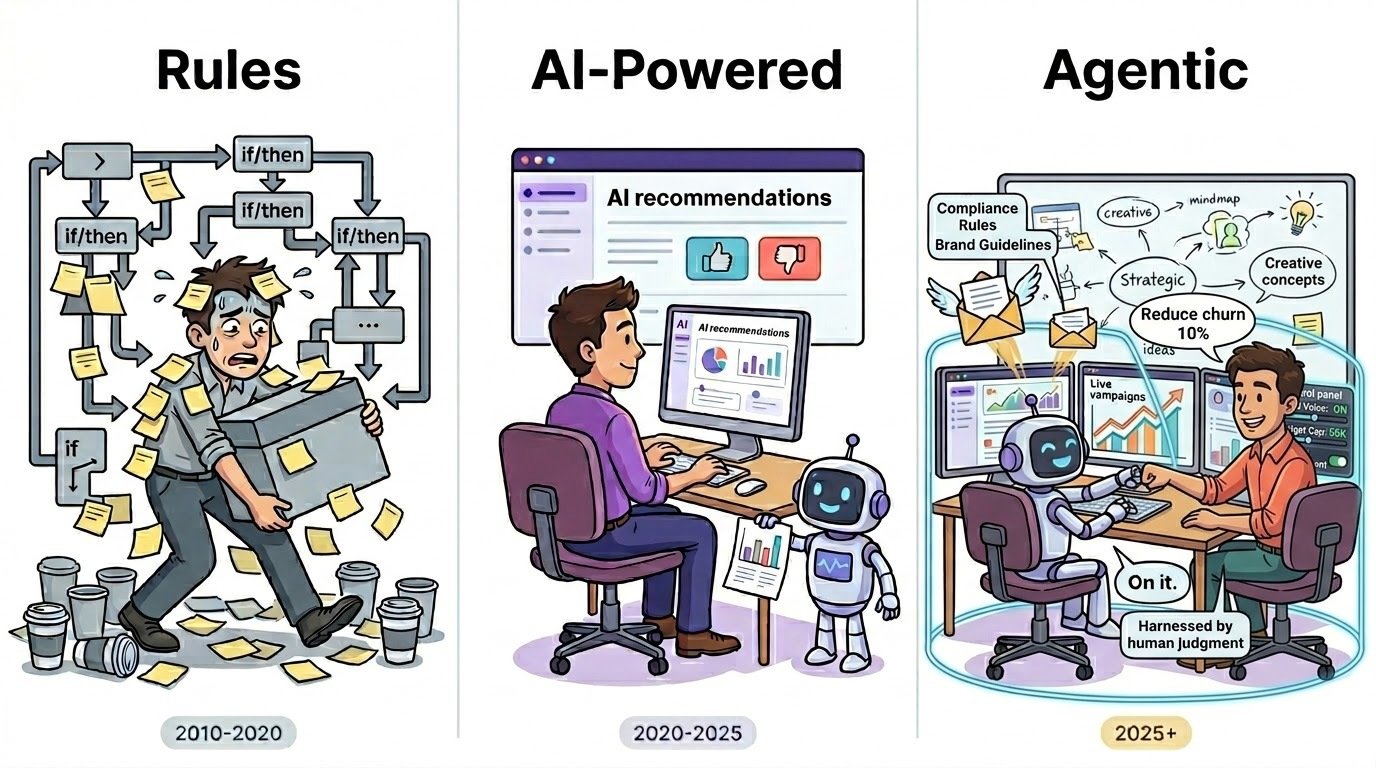
Marketing automation has evolved through three stages, each defined by where the intelligence lives:
Stage 1: Rule-Based (2010–2020). Marketers defined every workflow manually. If the rules were wrong, the automation was wrong at scale. No learning, no adaptation.
Stage 2: AI-Powered (2020–2025). Predictive models began optimizing send times, recommending segments, and scoring leads. Better outcomes, but still bottlenecked by human bandwidth — the AI suggested, the marketer still decided.
Stage 3: Agentic (2025+). AI agents operate autonomously within defined guardrails. They plan campaigns, execute across channels, and learn from outcomes in a closed feedback loop — deciding, acting, and improving in seconds rather than days.
The critical difference between Stage 2 and Stage 3 is the feedback loop. In Stage 2, results flow back to the marketer, who reviews a report and makes changes next week. In Stage 3, results flow back to the AI agent, which adapts immediately.
When data, intelligence, and execution live on separate platforms — a warehouse here, a reverse ETL pipe there, an external ESP on the other side — the loop breaks. Outcome data takes hours or days to return. The AI learns on yesterday's results, not today's.
Read More: Agentic Marketing: How AI Agents Transform Campaigns
Harnessed by Human Judgment
The more you automate, the more human judgment matters — not less.
AI can optimize send times, select channels, and generate variants at scale. But it cannot decide whether a campaign is appropriate for a sensitive moment. It cannot judge whether a discount undermines brand positioning. It cannot tell if a personalization crosses the line from helpful to invasive.
| Automate This | Keep Human |
|---|---|
| Send-time optimization | Brand voice and tone |
| Audience segmentation | Ethical boundaries and compliance |
| Content variant testing | Creative direction and storytelling |
| Budget reallocation | Strategic priorities and business context |
| Performance monitoring | "Is this the right thing to do?" |
The marketer's role shifts from building and operating campaigns to directing and governing them. Less time in the workflow builder. More time on strategy, creativity, and customer understanding.
How to Choose an AI Marketing Automation Platform
Feature lists are misleading. Every vendor claims AI. What actually matters is the architecture underneath:
- Does it unify customer data natively? If you need to pipe data from a separate CDP or warehouse before AI can use it, the feedback loop is already broken.
- Is the AI embedded or bolted on? A subject line optimizer on a legacy workflow engine is not AI marketing automation. Does the AI make decisions across the entire campaign lifecycle?
- How fast is the feedback loop? If results involve "nightly batch sync" or "export to warehouse," the loop is too slow for real-time learning.
- Can a marketer use it without engineering? If building campaigns requires SQL, scripting, or a dedicated ops team, it's a developer tool — not marketing automation.
- What are the guardrails? Can you set brand safety, compliance, and ethical rules that AI cannot override?
The fundamental question is architectural: do data, intelligence, and execution live on the same platform — or are they stitched together across multiple tools?
Why Your CDP and AI Marketing Automation Should Be One Platform
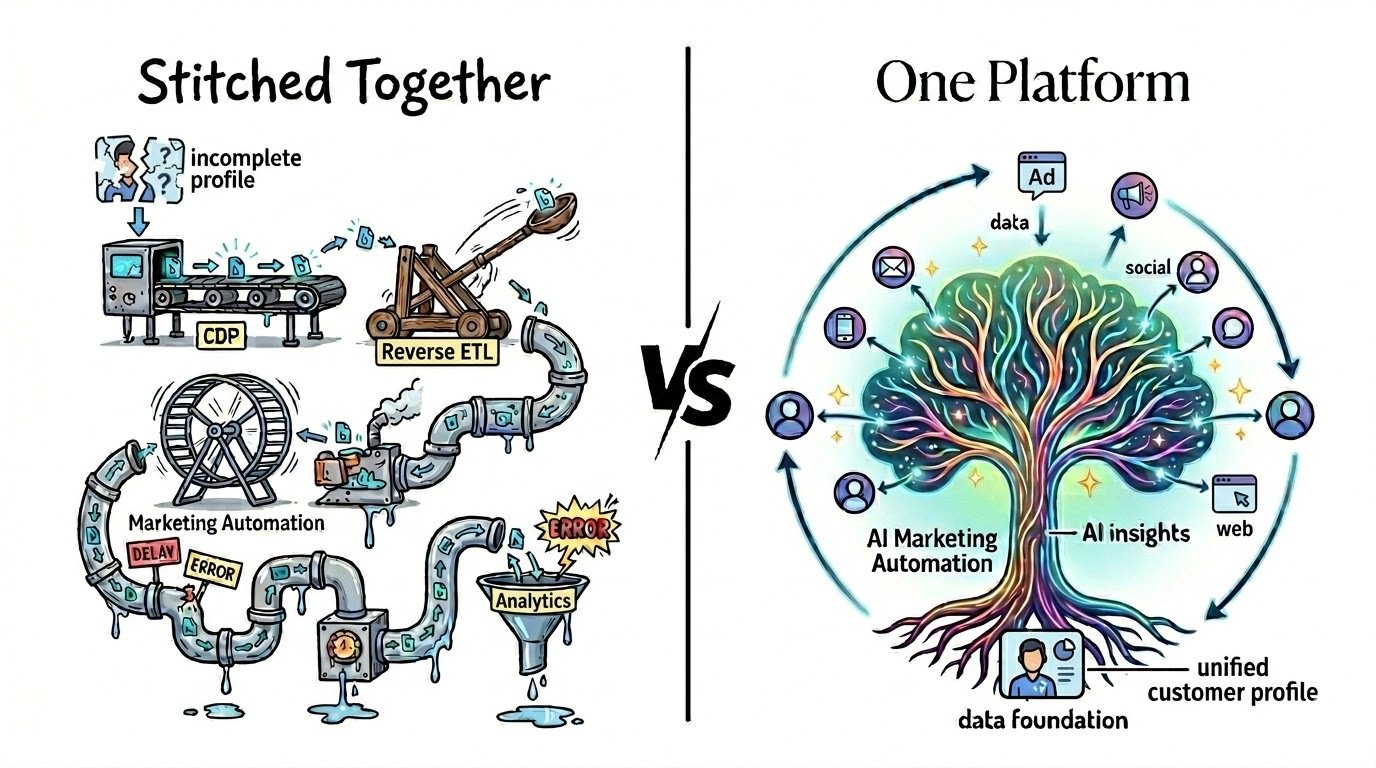
Think about it: a CDP collects and unifies customer data. A marketing automation platform uses customer data to send messages. They read and write the same profiles, serve the same teams, and optimize for the same outcomes.
So why are they separate products?
The answer is history, not logic. CDPs emerged because marketing automation platforms couldn't unify data. Marketing automation platforms emerged because CRMs couldn't execute campaigns. Each tool solved one gap — and created a new seam.
Every seam has a cost:
- Data latency. Profiles sync between tools on a schedule, not in real time. The AI is always learning from the past.
- Context loss. The CDP knows the customer opened an email. The ESP knows they clicked. Neither knows both — unless you stitch them together manually.
- Vendor finger-pointing. When deliverability drops or attribution breaks, which vendor owns the problem? The CDP? The ESP? The analytics tool?
- Compounding cost. Separate contracts, separate implementations, separate support teams, separate training.
When data, decisioning, and execution live on one platform, the seams disappear. The feedback loop closes. The AI has full context. And the marketer works in one place instead of five.
Treasure Data combines a CDP (Customer Data Platform), Marketing Automation (Engagement AI Suite), AI decisioning, and autonomous AI agents in a single platform — not because bundling is convenient, but because the architecture demands it. A closed feedback loop cannot cross vendor boundaries.
Getting Started
Don't start with the tool. Start with the data.
- Audit your data landscape. Map every customer data source. Identify silos, gaps, and quality issues.
- Pick one high-impact use case. Email optimization, predictive segmentation, or churn prevention are common starting points.
- Close the feedback loop. Make sure campaign results flow back to your customer profiles in real time — not in a weekly CSV export.
- Scale with agents. Once your data foundation is solid and your first use case is delivering, expand to autonomous campaign execution.
The platforms that call themselves "marketing automation" automated the easy part — the send. The hard part — the thinking, the deciding, the learning — was always left to you.
Marketing automation and AI belong together. But AI only changes the game if the data is ready.
Frequently Asked Questions
How does AI automate marketing?
AI automates marketing by replacing manual rule-building with autonomous decision-making. Instead of a marketer configuring "if cart abandoned, send email in 24 hours," AI evaluates each customer's complete profile — browsing patterns, purchase history, channel preferences, support interactions — and autonomously determines the best action, channel, timing, and content for that individual. The marketer sets the objective and guardrails; the AI handles execution, measurement, and optimization in a continuous loop.
How is AI marketing automation different from traditional marketing automation?
Traditional marketing automation executes predefined workflows — a human builds the logic, and the platform follows it. AI marketing automation designs and optimizes the workflows autonomously. Traditional automation applies the same rules to entire segments; AI automation makes individualized decisions per customer. Traditional automation requires manual A/B testing and optimization cycles; AI automation learns continuously from every interaction and self-improves in real time.
What data does AI marketing automation need to work effectively?
AI marketing automation needs unified customer data from every touchpoint — not just email opens and clicks. This includes web browsing behavior, purchase history, app activity, support interactions, ad engagement, and offline events. The more complete the customer profile, the better the AI's decisions. This is why a customer data platform (CDP) is the ideal data foundation — it merges fragmented data into a single, real-time profile that the automation AI can act on.