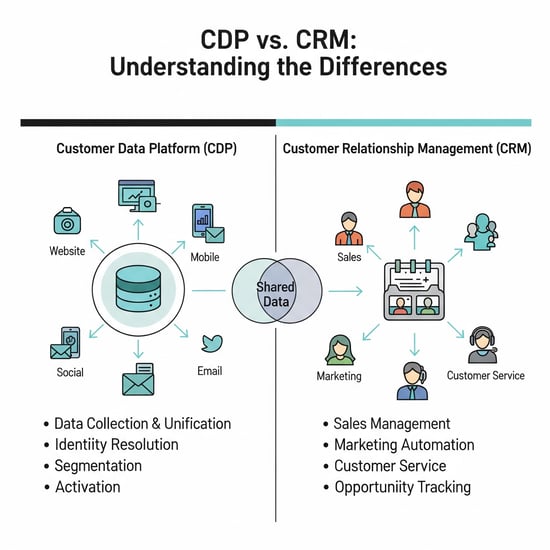
CDP vs CRM: What's the Difference?
A CRM manages direct customer relationships — tracking sales interactions, support tickets, and pipeline. A CDP unifies all customer data from every source into a single profile that powers personalization, AI decisioning, and autonomous agents. They're complementary: the CRM feeds data into the CDP, and the CDP makes the CRM smarter.
The confusion is understandable. Both store customer data. Both help teams engage customers. But in 2026, the gap between them is widening — because CDPs are becoming the infrastructure AI agents access, while CRMs remain the tool humans use to manage relationships.
CRM vs CDP at a Glance
| Capability | CRM | CDP |
|---|---|---|
| Primary purpose | Manage sales interactions and customer relationships | Unify all customer data for marketing, analytics, and AI activation |
| Data sources | Manual entry + sales/service integrations | 400+ sources: web, app, POS, CRM, ads, IoT — automatic ingestion |
| Data types | First-party, known contacts, structured | First, second, and third-party; known + anonymous; structured + unstructured |
| Identity resolution | Manual or basic matching (email, phone) | AI-powered, cross-device, persistent IDs across all channels |
| Update frequency | When a human updates a record | Real-time streaming — profiles update as customers act |
| Analytics | Pipeline reports, win/loss analysis | Predictive analytics, propensity scoring, AI-driven segmentation |
| AI / agent access | Limited — designed for human users | Full API + CLI + real-time streaming for autonomous agents |
| Primary users | Sales, service, account management | Marketing, data science, AI agents, and every downstream system |
| Best for | Sales pipeline, relationship tracking, service management | AI personalization, autonomous decisioning, journey orchestration |
What Is a CRM?
A customer relationship management (CRM) system is a platform for managing your company's direct interactions with customers and prospects. Sales teams track deals, service teams log tickets, and account managers maintain relationship history — all in one place.
CRMs excel at structured, human-driven workflows: pipeline management, forecasting, quote-to-cash, and customer service routing. They're the operational backbone of sales and service teams.
What CRMs don't do well: unifying data from dozens of external sources, resolving anonymous identities across devices, or providing real-time behavioral data to AI systems.
What Is a CDP?
A customer data platform (CDP) is a unified customer database that collects data from every channel and touchpoint, resolves identities, and makes complete customer profiles accessible to marketing, sales, service — and in 2026, to AI agents that autonomously personalize every customer interaction.
CDPs emerged because marketers needed what CRMs couldn't provide: a single, real-time view of every customer behavior across every channel — not just the interactions logged by a sales rep.
How Companies Use CRMs vs CDPs
CRM use cases
- Sales pipeline management — Track deals from lead to close
- Forecasting — Predict revenue based on pipeline stage and history
- Customer service — Log tickets, route cases, track resolution
- Account management — Maintain relationship history and contacts
- Marketing automation — Basic campaign tracking and lead scoring
CDP use cases
- Marketing orchestration — Personalize campaigns across email, web, mobile, and ads from one unified profile
- AI-powered segmentation — Discover segments humans would miss, updated in real time
- Media suppression and optimization — Stop wasting ad spend on already-converted customers
- Predictive analytics — Score churn risk, purchase propensity, and lifetime value
- Autonomous email optimization — AI agents select the right message, timing, and offer for each individual
- Account-based B2B engagement — Segment and engage prospects within target accounts
- Data unification and governance — Centralize customer data, enforce compliance across regions
The Data Difference: Why It Matters
CRM data is transactional
A CRM records what a sales rep logs: who bought what, when, and through which deal. The data is structured, contact-centric, and updated when a human takes action. It's excellent for managing known relationships — but it misses everything that happens outside the sales process.
CDP data is behavioral, real-time, and multi-dimensional
A CDP captures what a customer does, not just what a rep records: page views, product interactions, email opens, app sessions, ad clicks, in-store visits, support conversations — all unified into one profile, updated in real time. This behavioral depth is what makes AI personalization and autonomous decisioning possible.
A CRM tells you a customer bought running shoes last month. A CDP tells you they've been browsing trail running gear for two weeks, opened three emails about hiking, visited your store locator twice, and are 87% likely to purchase within 7 days — then triggers the right offer on the right channel automatically.
Why CDPs Matter More in the AI Era
The gap between CRM and CDP is widening in 2026 — because of AI agents.
CRMs were built for humans: click-through dashboards, manual data entry, structured workflows. CDPs are evolving into infrastructure that AI agents access programmatically — through APIs, CLIs, and real-time streaming.
When an autonomous marketing agent needs to decide the next-best action for a customer in milliseconds, it doesn't open Salesforce and click through a contact record. It queries the CDP's API, gets a unified profile with 500+ attributes, and makes a decision — governed by RBAC, consent, and audit controls operating at machine speed.
This doesn't mean CRMs become obsolete. Sales teams still need CRMs. But the data foundation for AI — the layer that agents, models, and autonomous systems depend on — is the CDP.
Do You Need a CRM, a CDP, or Both?
Choose a CRM if:
- Your primary need is sales pipeline management and customer service
- Your team manually manages customer relationships
- You have a small number of data sources (under 5)
Choose a CDP if:
- You need to unify customer data from 10+ sources
- You want AI-powered personalization across every channel
- You're deploying or planning to deploy AI agents that need real-time customer data
- You need to comply with GDPR, CCPA, or APPI across multiple regions
Use both when:
- Your CRM handles sales and service, while your CDP unifies all customer data and powers marketing, AI, and analytics
- The CDP feeds enriched profiles back to the CRM — giving sales reps context they'd never have otherwise
- AI agents use the CDP for real-time decisions, while humans use the CRM for relationship management
Real-World Impact
Organizations that combine CRM + CDP report measurable outcomes:
- Subaru achieved a 350% increase in click-through rates by unifying data that was previously scattered across sales, marketing, and service silos — then activating it through personalized campaigns
- Anheuser-Busch InBev unified 2,000 data sources and 90 million customer records into a single CDP, enabling coordinated marketing across dozens of brands that no CRM could handle alone
Explore the CDP Stack
- What Is a Customer Data Platform? — AI resets the definition in 2026
- CDP vs DMP — First-party data vs anonymous audiences
- AI Marketing — The 3 waves reshaping how teams plan, execute, and measure
- Agentic Marketing — AI agents that run campaigns, harnessed by humans
- AI Decisioning — Real-time, autonomous next-best-action
CDP vs CRM: Frequently Asked Questions
Evaluating CDPs? Request a custom demo to see Treasure Data in action.
What is the difference between a CDP and a CRM?
A CRM manages direct sales interactions and customer relationships using structured, manually-entered data. A CDP unifies all customer data — behavioral, transactional, and demographic — from every source into real-time profiles that power personalization, AI decisioning, and autonomous agents across every channel.
Can a CDP replace a CRM?
No — they serve different purposes. A CRM is the operational tool sales and service teams use daily. A CDP is the data foundation that unifies information from the CRM and dozens of other sources. Most enterprises use both: the CDP feeds enriched profiles back to the CRM, making sales reps more effective.
Why do companies need a CDP if they already have a CRM?
CRMs only see what sales reps log. CDPs see everything — web behavior, app usage, ad interactions, email engagement, in-store visits, and more. This complete behavioral view enables AI-powered personalization and predictive segmentation that CRMs alone cannot provide.
How do CDPs and CRMs work together?
The CDP collects and unifies data from the CRM and every other source, resolves identities, and builds complete customer profiles. These enriched profiles flow back to the CRM, giving sales reps real-time context. Meanwhile, marketing teams and AI agents use the CDP directly for campaign orchestration and autonomous decisioning.
How does AI change the CDP vs CRM dynamic?
AI agents need programmatic, real-time access to unified customer data — through APIs and CLIs, not dashboards. CRMs weren't built for this. CDPs are evolving into the data infrastructure AI agents depend on, while CRMs remain the human-facing relationship management tool. The two systems become more complementary, not less.