CDP vs DMP: The DMP Era Is Over — Oracle and Salesforce Shut Theirs Down [2026]
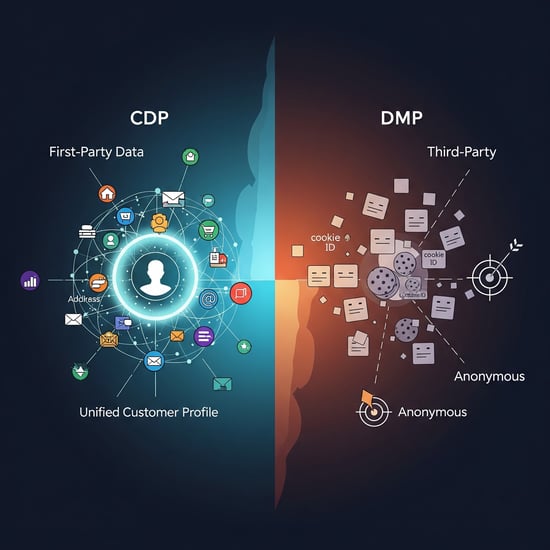
CDP vs DMP: What's the Difference?
A CDP unifies first-party customer data — behavioral, transactional, and demographic — into persistent profiles that power personalization, analytics, and AI agents across every channel. A DMP collects anonymous, third-party data for ad targeting and audience acquisition, with short retention windows and no persistent identity.
But here's the reality in 2026: most standalone DMP vendors have shut down or pivoted. Oracle shut down its entire advertising division — including BlueKai — on September 30, 2024. Salesforce declared End of Life for Audience Studio (formerly Krux) on February 1, 2024. The two largest enterprise DMP vendors exited the market within months of each other.
So why does this comparison still matter? Because thousands of enterprises are still migrating from DMP-centric architectures to CDP-first strategies. And the organizations searching "CDP vs DMP" in 2026 aren't choosing between the two — they're figuring out how to replace one with the other.
CDP vs DMP at a Glance
| Capability | CDP | DMP |
|---|---|---|
| Primary purpose | Unify all customer data for marketing, analytics, and AI activation | Segment anonymous audiences for ad targeting and acquisition |
| Data sources | First, second, and third-party from 400+ sources | Primarily third-party; limited first-party (anonymized) |
| Identity type | PII-based: names, emails, phone numbers, persistent cross-device IDs | Anonymous: cookies, device IDs, IP addresses |
| Identity resolution | AI-powered, cross-device, persistent profiles | Cookie-based, temporary, no cross-device stitching |
| Data retention | Long-term — full customer lifetime history | Short-term — typically less than 90 days |
| Data granularity | Raw, event-level detail with unlimited storage | Aggregated, high-level segment data |
| Privacy / PII | Stores PII with consent management, RBAC, and audit trails | Cannot store PII — anonymity is core to the model |
| Use cases | All of marketing: personalization, journey orchestration, AI decisioning, media optimization | Advertising only: ad targeting, lookalike audiences, media buying |
| AI / agent access | Full API + CLI + real-time streaming for autonomous agents | Not designed for AI agents — batch-oriented, no real-time API |
| Cookie deprecation impact | Minimal — built on first-party data | Existential — core data source is disappearing |
| Best for | AI personalization, intelligent segmentation, cross-channel orchestration | Programmatic advertising, audience extension, media buying |
What Is a CDP?
A customer data platform (CDP) is a unified customer database that collects data from every channel and touchpoint, resolves identities across devices, and makes complete customer profiles accessible to marketing, sales, service — and in 2026, to AI agents that autonomously personalize every customer interaction.
CDPs store PII, support unlimited data retention, and integrate with the entire martech and adtech stack. They're the single source of truth for customer data — not just for advertising, but for every customer-facing function.
What Is a DMP?
A data management platform (DMP) collects and organizes anonymous, primarily third-party audience data for ad targeting and media buying. DMPs package audiences into segments — "males 25-34 interested in sports cars" — that advertisers use to target display, video, and programmatic campaigns.
DMPs excel at audience extension and lookalike modeling. But they have fundamental limitations: no PII storage, no persistent identity, short data retention (typically under 90 days), and complete dependence on cookies and device IDs — a data source that is rapidly disappearing.
5 Reasons CDPs Win Over DMPs
1. First-party data ownership
A CDP stores all your first-party data — website behavior, purchase history, email engagement, app activity, in-store visits — tied to persistent, identity-resolved profiles. This is your competitive advantage. No competitor can access it.
A DMP's data is inherently shared. The same third-party audience segments your DMP provides are available to your competitors who use the same DMP. It's an equalizer, not a differentiator.
2. Persistent identity across channels
CDPs build persistent customer profiles that follow a person across devices, channels, and sessions — from anonymous first visit through known customer and beyond. This cross-device, cross-channel identity is what makes real personalization possible.
DMPs build temporary profiles based on cookie IDs that expire. When the cookie is gone, so is the customer. No persistent identity means no longitudinal customer understanding.
3. Raw data with unlimited retention
CDPs capture raw, event-level data with granular detail and store it for the full customer lifetime. You can query what a customer did 3 years ago as easily as what they did 3 minutes ago.
DMPs collect aggregated data and typically retain it for less than 90 days. Historical analysis and long-term customer value modeling are impossible.
4. Beyond advertising — the full martech stack
CDPs syndicate data to any system — email, web personalization, mobile, social, advertising, service, analytics. A CDP powers the entire marketing operation, not just ad campaigns.
DMPs were designed for one job: build audiences for advertising. They can't power email personalization, service interactions, or AI-driven campaign automation.
5. AI agent readiness
In 2026, AI agents need real-time, programmatic access to unified customer profiles — through APIs and CLIs, not batch exports. CDPs are evolving into agent infrastructure. DMPs were never designed for this — they're batch-oriented systems with no real-time API layer for autonomous decisioning.
What Happened to DMPs
DMPs were built on a foundation of third-party cookies and device IDs. That foundation didn't just crack — it collapsed:
- Safari and Firefox blocked third-party cookies years ago
- Chrome Privacy Sandbox replaced the last major holdout
- GDPR, CCPA, APPI restricted third-party data collection and sharing globally
- Apple's ATT gutted device-level tracking on iOS
The result was an industry shakeout. Oracle shut down its entire advertising division — BlueKai, Datalogix, Moat, and Grapeshot — after advertising revenue fell to $300 million from a peak of over $2 billion. Salesforce retired Audience Studio (formerly Krux), sunsetting all 42 products in the DMP suite. The two largest enterprise DMP vendors exited the market within months of each other.
What remains is the function, not the product category. Audience enrichment, lookalike modeling, and programmatic targeting still happen — but they happen inside CDPs and ad platforms, powered by first-party data instead of third-party cookies. The standalone DMP as a category is effectively over.
How CDPs and DMPs Work Together
CDPs and DMPs aren't mutually exclusive. For organizations still running programmatic advertising, they complement each other:
- CDP → DMP: Feed first-party conversion data and high-value customer segments into your DMP to improve ad targeting and build better lookalike audiences
- DMP → CDP: Enrich CDP profiles with third-party audience attributes to understand customers in broader context
- CDP for suppression: Use your CDP to suppress already-converted customers from DMP-targeted ad campaigns — saving millions in wasted ad spend
That said, the trend is clear: as first-party data becomes the primary source of competitive advantage and AI agents become the primary consumers of customer data, the CDP's role is expanding while the DMP's role is narrowing.
Explore the CDP Stack
- What Is a Customer Data Platform? — AI resets the definition in 2026
- Marketing CDP — Unify data, activate AI, and prove ROI
- Enterprise CDP — Scale, governance, and AI agent readiness
- CDP vs CRM — When you need which, and why AI changes everything
- AI Marketing — The 3 waves reshaping how teams plan, execute, and measure
- Agentic Marketing — AI agents that run campaigns, harnessed by humans
- AI Decisioning — Real-time, autonomous next-best-action
CDP vs DMP: Frequently Asked Questions
Evaluating CDPs? Request a custom demo to see Treasure Data in action.
What is the difference between a CDP and a DMP?
A CDP unifies first-party customer data — behavioral, transactional, and demographic — into persistent, identity-resolved profiles that power personalization, analytics, and AI agents. A DMP collects anonymous, third-party data for ad targeting with short retention windows and no persistent identity.
Can a CDP replace a DMP?
For many organizations, yes. As cookie deprecation eliminates the DMP's primary data source, CDPs are absorbing DMP functions — audience building, lookalike modeling, and ad suppression — while adding capabilities DMPs never had: persistent identity, real-time personalization, and AI decisioning.
How do CDPs and DMPs work together?
A CDP feeds first-party conversion data into the DMP to improve ad targeting. The DMP enriches CDP profiles with third-party audience attributes. Together, they bridge known customer retention (CDP) and anonymous audience acquisition (DMP). CDPs also power media suppression to prevent wasting DMP-targeted ad spend on already-converted customers.
Why did standalone DMPs shut down?
DMPs depended on third-party cookies and device IDs — data sources that disappeared due to browser restrictions and privacy regulations. Oracle shut down BlueKai and its entire ad division in September 2024. Salesforce retired Audience Studio (Krux) in February 2024. The DMP function — audience targeting and lookalike modeling — now lives inside CDPs and ad platforms, powered by first-party data.
How does AI change the CDP vs DMP dynamic?
AI agents need real-time, programmatic access to unified customer profiles — through APIs and CLIs, not batch audience exports. CDPs are evolving into the data infrastructure AI agents depend on. DMPs were never designed for this level of programmatic, real-time access.