You spent three weeks building a customer journey map. It has five stages, twelve touchpoints, and four personas. It lives in a slide deck that nobody has opened since the offsite.
Meanwhile, your actual customers are doing things your map never predicted. They're skipping stages. Entering mid-journey from a channel you didn't include. Bouncing between touchpoints in an order that makes no sense on paper — but perfect sense when you look at their data.
The problem isn't that you mapped the journey wrong. The problem is that static maps can't describe dynamic customers.
This guide covers both sides: how to build a customer journey map that actually works, and why the best maps are no longer static documents — they're living, data-driven systems that adapt in real time.
What Is Customer Journey Mapping?
Customer journey mapping is the process of creating a visual representation of every interaction a customer has with your brand — from first discovery through purchase and beyond. A customer journey map documents the stages, touchpoints, channels, emotions, and pain points that shape how customers experience your business.
Done well, a customer journey map aligns your entire organization around the customer's perspective. Done poorly, it becomes a static artifact that describes how you think customers behave rather than how they actually do.
The distinction matters. McKinsey found that companies that manage the entire customer journey — not just individual touchpoints — see 10-15% revenue increases and 20% improvements in customer satisfaction. Forrester's research reinforces this: organizations that excel at journey management achieve 1.6x higher customer lifetime value and 1.9x higher return on marketing spend. But capturing that value requires maps that reflect reality, not assumptions.
Why Traditional Journey Maps Break Down
The traditional approach to customer journey mapping has a fundamental problem: it assumes customers follow a predictable path. They don't.
The linear fallacy
Most journey maps show a neat progression: awareness → consideration → decision → purchase → loyalty. In reality, customers jump between stages, revisit earlier phases, and enter from touchpoints you never planned for. A customer might discover your brand through a podcast mention, research competitors on their phone during lunch, abandon a cart on desktop, get retargeted on Instagram three days later, and finally convert through a direct Google search.
No static diagram captures this. And when your map doesn't match reality, every decision based on it — content strategy, ad spend, email cadence — is built on a flawed foundation.
The snapshot problem
Traditional journey maps are created at a point in time — during an offsite, a planning cycle, or a quarterly review. But customer behavior shifts continuously. A journey map created in January may be obsolete by March. New channels emerge, competitors change the landscape, and customer expectations evolve faster than most teams can update a PowerPoint.
The data gap
The biggest limitation of static maps is what they leave out. A workshop-driven journey map captures what stakeholders believe customers do, filtered through the biases of whoever is in the room. It rarely incorporates:
- Actual behavioral data across channels
- Real-time signals like browse-to-cart timing or support interactions
- Individual-level variation within segments
- Cross-device and cross-session paths
According to Forrester, 73% of companies say improving customer journey understanding is their top priority — yet fewer than 30% have the data infrastructure to map journeys based on actual behavior rather than assumptions.
How to Build a Customer Journey Map That Actually Works
A good journey map still starts with the fundamentals. But the fundamentals have evolved.
Step 1: Define your personas with data, not assumptions
Start by identifying the core customer types whose journeys you want to map. But instead of building personas in a workshop based on anecdotes, ground them in behavioral data.
Use your customer data platform, CRM, or analytics tools to identify real patterns: What are the most common paths to purchase? Where do customers drop off? Which segments have the highest lifetime value, and what do their journeys look like compared to low-value segments?
AI-powered segmentation can discover persona clusters that humans would never identify manually — groups defined not by demographics but by behavioral patterns that actually predict outcomes.
Step 2: Map the real touchpoints, not the planned ones
List every touchpoint where customers interact with your brand — but do it from data, not memory. Pull from your analytics, ad platforms, CRM, support tickets, and social channels. The list will be longer than you expect.
Typical enterprise touchpoints include:
- Discovery: organic search, paid ads, social media, referrals, podcasts, review sites
- Evaluation: website pages, comparison content, demos, free trials, webinars
- Purchase: e-commerce checkout, sales conversations, contract signing
- Onboarding: welcome emails, setup guides, first-use experience
- Retention: support interactions, product updates, loyalty programs, personalized email
- Advocacy: reviews, referrals, case studies, community participation
Step 3: Identify the moments that matter
Not all touchpoints are equal. Some are "moments of truth" — interactions where the customer's trajectory changes dramatically based on their experience. A bad support interaction after purchase can erase all the goodwill built during a great sales process. A well-timed, relevant offer can convert a casual browser into a loyal customer.
Prioritize these moments in your map. They're where investment has the highest ROI.
Step 4: Layer in emotions and friction points
The best journey maps capture not just what happens at each touchpoint, but how the customer feels. Where are they frustrated? Confused? Delighted? Where do they encounter friction — a slow-loading page, a confusing form, a gap between departments where information gets lost?
These emotional layers turn a process diagram into a strategic tool. They reveal where fixing a single friction point can unlock disproportionate value.
Step 5: Involve the right teams
Journey mapping should not be a marketing-only exercise. Involve:
- Sales — especially in B2B, they have direct insight into buyer hesitations and decision criteria
- Customer support — they see where customers struggle post-purchase
- Product — they understand the in-product experience and usage patterns
- Leadership — to ensure alignment and resource commitment
Each team sees a different slice of the journey. The map should synthesize all perspectives into a single view — which is why a unified data foundation matters more than any workshop exercise.
Step 6: Choose the right format
There are four major types of customer journey maps:
- Current-state maps — how customers experience your brand today
- Future-state maps — the ideal experience you're designing toward
- Day-in-the-life maps — the customer's full context beyond your brand
- Service blueprints — internal processes mapped against customer-facing touchpoints
Start with a current-state map grounded in data. Then use it to design the future state. Many teams start with a customer journey map template — from tools like Miro or Lucidchart — and customize it based on their specific data and business context.
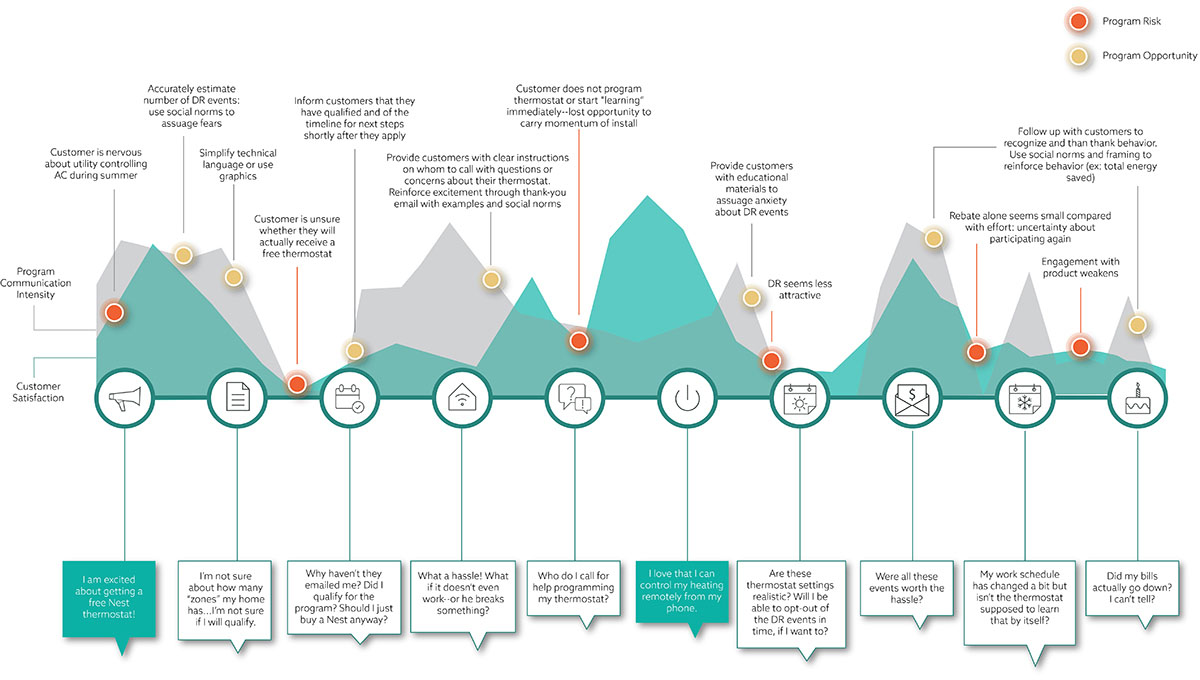
Customer Journey Mapping Examples: Static vs. Data-Driven
To see why the shift from static to data-driven mapping matters, consider two approaches to the same customer:
Example 1: Static map approach
A retail brand's journey map says: awareness (social ad) → consideration (product page) → purchase (cart → checkout). The map assumes a 3-day cycle. Marketing sets up a retargeting ad for anyone who viewed a product but didn't buy within 72 hours.
The problem: Customer A saw the social ad, browsed three product pages on mobile, called the store to ask about sizing, visited the physical store the next day, then purchased online a week later using a desktop. The static map captured one of those six touchpoints. The retargeting ad hit her the day after she already bought in-store.
Example 2: Data-driven journey approach
The same brand, powered by unified customer data, sees the complete path — social impression, mobile browse, phone call, store visit, desktop purchase. The AI recognizes the cross-channel pattern and suppresses the retargeting ad after the in-store purchase. Next time a customer shows a similar pattern (mobile browse → phone call), the system proactively sends store inventory information instead of a discount ad — because the data shows this path converts better with availability information than with price incentives.
Same customer. Same brand. Entirely different outcome — because the journey map was data-driven, not assumed.
From Static Maps to Living Journeys: The Data-Driven Shift
Here's where most journey mapping guides stop. They give you a framework, a template, and send you on your way. But the map you just built has the same fundamental problem as every other static map: it's already outdated.
The next evolution of customer journey mapping isn't a better diagram. It's a living, data-powered system that updates in real time as customers actually behave.
What changes with unified customer data
When your journey mapping is powered by a customer data platform that unifies every touchpoint — web, app, email, support, purchase, ad interaction — three things become possible:
1. You see the actual journey, not the assumed one. Instead of mapping what you think happens, you can visualize what actually happens — for every customer, in real time. The paths customers take, the touchpoints they skip, the moments where they stall or accelerate.
2. You discover journeys you never mapped. Data reveals patterns invisible to workshops. In many cases, a significant share of high-value customers follow paths that don't appear on any map — because nobody in the room knew about them. AI personalization thrives on these hidden patterns.
3. The map updates itself. When new channels emerge, when customer behavior shifts, when a competitor disrupts the market — a data-driven journey system reflects these changes automatically. No quarterly refresh needed.
Static maps vs. data-driven journeys
| Dimension | Static Journey Map | Data-Driven Journey |
|---|---|---|
| Source | Workshop assumptions | Real behavioral data |
| Update frequency | Quarterly at best | Real-time / continuous |
| Granularity | Persona-level (4-6 types) | Individual-level (every customer) |
| Channels covered | Planned touchpoints | All observed touchpoints |
| Actionability | Informs strategy discussions | Triggers automated actions |
| Adaptability | Manual revision | Self-adjusting based on new data |
How AI Transforms Journey Mapping Into Journey Orchestration
The real leap isn't from static to data-driven — it's from mapping to orchestration. When AI enters the picture, journey maps stop being descriptive and start being prescriptive.
AI-powered journey orchestration
Instead of a marketer looking at a map and deciding what to do, AI decisioning evaluates each customer's real-time position in their journey and autonomously selects the optimal next action — the right message, through the right channel, at the right moment.
- A customer showing high purchase intent skips the nurture sequence and goes straight to a personalized offer
- A loyal customer exhibiting early churn signals gets routed to a retention-focused experience
- A new visitor entering from an unexpected channel gets dynamically placed in the journey based on their behavior — not a predefined entry point
This is where AI marketing automation meets journey mapping. The map becomes the operating system — not a reference document.
The role of unified data
AI journey orchestration only works when the AI can see the complete customer picture. If your web data lives in one system, email data in another, and support data in a third, the AI is making decisions with fragments.
A customer data platform solves this by creating a single, unified profile for each customer — merging every interaction across every channel into one real-time view. This unified profile is what makes the leap from static maps to autonomous orchestration possible.
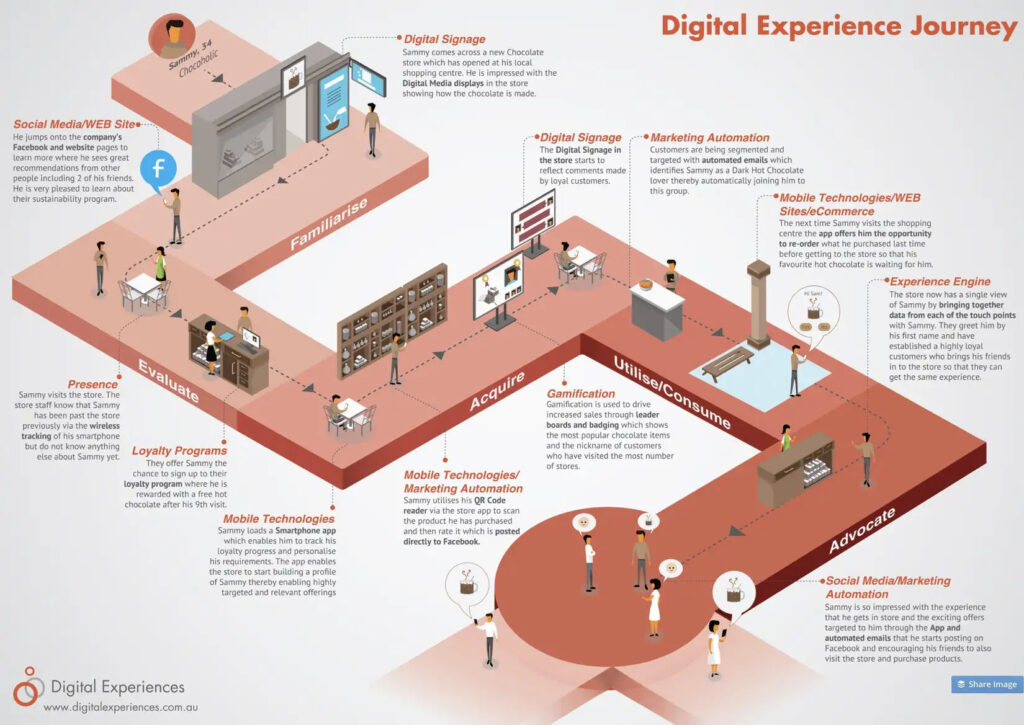
Getting Started: A Practical Roadmap
Phase 1: Build a data-grounded static map (Weeks 1-3)
Start with the fundamentals. Use the six steps above to create a current-state journey map — but ground every element in actual data, not assumptions. This gives you a baseline and reveals the biggest gaps between your assumed journey and reality.
Phase 2: Unify your customer data (Weeks 3-6)
Connect your data sources into a unified customer profile. Web analytics, CRM, email platform, support system, app data — everything feeding into one view per customer. This is the infrastructure that makes everything downstream possible.
Phase 3: Identify high-impact journey moments (Weeks 6-8)
Use your unified data to find the moments of truth — the touchpoints where small improvements drive outsized results. Focus your first optimization efforts here.
Phase 4: Pilot AI-driven orchestration (Weeks 8-12)
Start with one journey — new customer onboarding or cart abandonment recovery. Replace the static, rule-based sequence with AI-driven orchestration that adapts to each individual's behavior in real time. Measure the lift against your current approach.
Phase 5: Scale to autonomous journey management (Months 3+)
Expand AI orchestration across journeys. Set business objectives and guardrails. Let the system optimize paths, timing, and messaging autonomously — harnessed by human strategy and oversight.
Frequently Asked Questions
What is customer journey mapping?
Customer journey mapping is the process of visualizing every interaction a customer has with your brand, from first awareness through purchase and ongoing loyalty. It documents stages, touchpoints, channels, emotions, and friction points to align your organization around the customer's actual experience.
Why do most customer journey maps fail?
Most journey maps fail because they're built on assumptions rather than data, they're static documents that don't reflect changing customer behavior, and they describe persona-level averages instead of individual-level reality. The map becomes outdated the moment it's finished.
What is the difference between journey mapping and journey orchestration?
Journey mapping describes how customers experience your brand — it's diagnostic. Journey orchestration uses AI and real-time data to actively guide each customer through their optimal path — it's prescriptive. Mapping tells you what happened; orchestration determines what happens next.
What tools do you need for customer journey mapping?
Basic journey mapping requires visualization tools (Miro, Lucidchart, or even PowerPoint). Data-driven journey mapping requires analytics platforms and a customer data platform (CDP) to unify touchpoint data. AI journey orchestration requires a CDP with native AI decisioning and cross-channel activation capabilities.
How often should you update a customer journey map?
Static maps should be reviewed at least quarterly. But the better question is whether your map should be static at all. Data-driven journey systems update continuously as customer behavior changes — eliminating the need for manual revision cycles.
What is the role of a CDP in customer journey mapping?
A CDP unifies customer data from every touchpoint into a single profile, giving you the complete picture needed for accurate journey mapping. It transforms customer journey maps from workshop-driven assumptions into data-driven reality — and enables the shift from static maps to real-time, AI-powered journey orchestration.
What should a customer journey map template include?
A good customer journey map template should include: customer persona definition, journey stages (awareness through advocacy), touchpoints per stage, customer actions and emotions at each step, friction points and pain points, and metrics to measure success. Start with a template, then customize it with your actual behavioral data.
What are the 5 stages of customer journey mapping?
The five core stages are awareness (customer discovers your brand), consideration (they evaluate your offering), decision (they choose to purchase), retention (they continue using your product), and advocacy (they recommend you to others). In practice, customers rarely follow these stages linearly — which is why data-driven journey mapping matters.
Ready to move from static maps to living, data-driven journeys? Explore how Treasure Data powers real-time journey orchestration →