Your AI personalization is probably broken — and the AI is not the problem.
Here is what we see over and over at enterprises with hundreds of customer attributes and dozens of data systems: the personalization engine works fine. It is just starving. Starving for unified data, and starving for creative.
Think about it. Your AI can only personalize based on what it can see. If your email platform does not know about yesterday's support call, it will send a cross-sell offer to a frustrated customer. If your web personalization tool cannot access in-app behavior, it treats a power user like a first-time visitor. Fragmented data makes smart AI look dumb.
But even when you solve the data problem — and most companies have not — there is a second bottleneck that almost nobody talks about: you do not have enough creative. Your AI knows exactly who to target and when. But if you only have 10 content variants for a million customers, 99% of them get something generic. The targeting is precise; the experience is not.
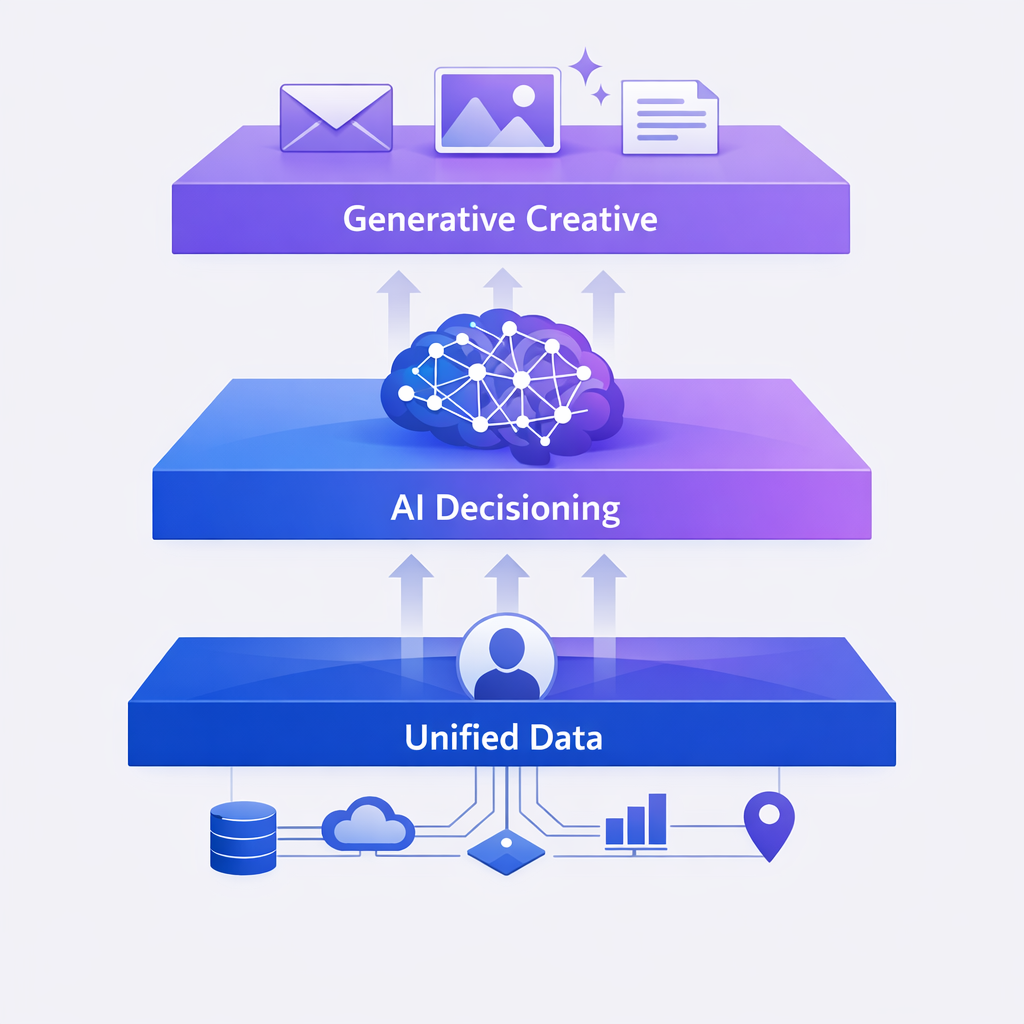
This is why AI personalization requires three layers working together: unified data, intelligent decisioning, and AI-generated creative. Miss any one, and the whole system underperforms. In this guide, we break down each layer, show where most programs stall, and lay out the practical path from rule-based targeting to agentic marketing.
What Is AI Personalization?
AI personalization is the use of artificial intelligence to deliver individually tailored content, offers, and experiences to each customer in real time, based on their complete data profile across every channel and touchpoint. It goes beyond segments — the AI evaluates each person's history, behavior, predicted intent, and lifetime value to autonomously select the optimal experience.
That is the textbook answer. Here is what it means in practice: AI personalization is not just about what you show a customer. It is about when you show it, where you deliver it, and whether to engage at all. The best systems make all four decisions simultaneously, for every individual, in milliseconds.
What AI Personalization Is Not
Three common practices are often mistaken for AI personalization:
- Mail merge is not personalization. Inserting a first name into an email template does not change the experience — it changes a string.
- Segment-based targeting is not individual personalization. Showing different homepage banners to a segment of 50,000 is better than showing everyone the same thing, but it is still one-size-fits-most, not 1:1.
- Collaborative filtering alone is not enough. "Customers who bought X also bought Y" is one useful signal, but true AI personalization synthesizes hundreds of signals — behavioral, contextual, predictive — not just purchase co-occurrence.
True AI personalization evaluates the complete context of an individual — their history, preferences, real-time behavior, predicted intent, and lifetime value — and autonomously selects the optimal experience across every channel.
Layer 1: The Data Problem — Why AI Personalization Fails Without Unified Profiles
Companies that excel at personalization generate 40% more revenue from those activities than average players (McKinsey, 2023). Personalization can also reduce customer acquisition costs by up to 50% (Deloitte). Yet most enterprises struggle to capture these gains. The reason is almost always data.
The Fragmented Data Reality
A typical enterprise has customer data spread across 15 to 25 systems: CRM, marketing automation, e-commerce platform, customer support, mobile app, point-of-sale, loyalty programs, ad platforms, and more. Each system holds a piece of the customer story, but none holds the whole narrative.
When AI models are trained on incomplete data, three things go wrong:
- Blind spots lead to irrelevant experiences. A customer who just called support to complain gets a cross-sell email an hour later — because the email system does not know about the support interaction.
- Duplicate profiles create conflicting signals. The same customer appears as three different people across systems, receiving contradictory messages on different channels.
- Historical context gets lost. Without a unified timeline, AI cannot distinguish between a loyal customer exploring new categories and a new visitor browsing casually.
Why CDPs Are the Foundation
A customer data platform solves this by creating a single, unified customer profile that ingests data from every source — first-party, second-party, and third-party — and resolves identities across devices, channels, and sessions.
This unified profile becomes the input layer for AI personalization. Instead of asking "what do we know about this customer in this system?", the AI can ask "what do we know about this customer, period?"
The difference is not incremental. It is the difference between personalization that feels random and personalization that feels like the brand actually knows you.
Layer 2: The Creative Bottleneck — Why Data and Decisioning Are Not Enough
Even with perfect data and smart decisioning, there is a third pillar that most personalization strategies overlook: creative supply.
The Math Does Not Work
Consider a mid-size enterprise with:
- 100 micro-segments identified by AI
- 5 active channels (email, web, app, SMS, paid social)
- 3 customer journey stages (awareness, consideration, conversion)
- 2 offer types per stage
That is 3,000 unique creative assets needed for true segment-level personalization. For individual-level personalization? The number becomes effectively infinite.
Most marketing teams produce 20 to 50 creative variants per campaign. This means no matter how sophisticated the AI's targeting and timing, 99% of customers see something that was not designed for them. The personalization strategy hits a ceiling — not from lack of intelligence, but from lack of creative inventory.
Generative AI Solves the Supply Problem
Large language models and image generation models fundamentally change this equation. Instead of a human designer creating 50 variants and an AI selecting the best match, generative AI can:
- Compose — Write unique copy for each customer based on their profile, history, and predicted preferences.
- Assemble — Dynamically combine visual elements, layouts, and content blocks into individualized experiences.
- Iterate — Generate multiple variants, test them in real time, and evolve the creative based on actual performance.
The critical requirement is the same as always: the generative AI needs access to rich, unified customer data. A model generating personalized content without customer context produces generic output. A model with access to a CDP's unified profiles produces content that feels individually crafted.
This is why the convergence of CDPs and generative AI is the most important trend in personalization today. The CDP provides the who and why. The decisioning engine provides the when and where. And generative AI provides the what — at unlimited scale.
Three Levels of AI Personalization
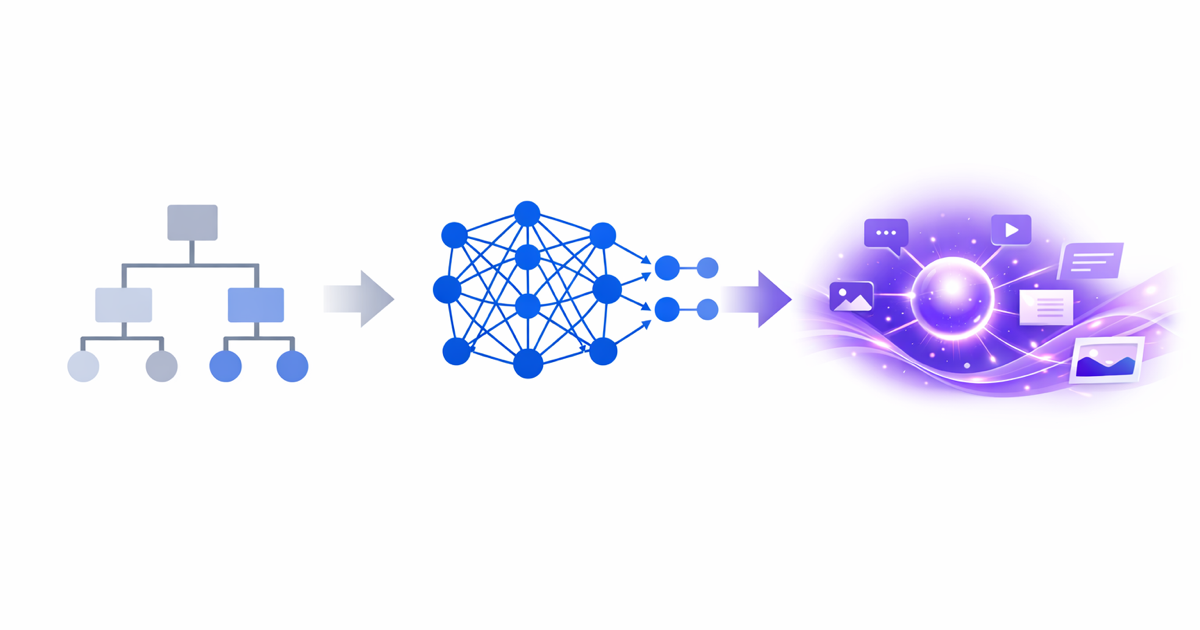
AI personalization is not a single capability — it is a spectrum. Understanding where your organization sits on this spectrum reveals what is possible and what is holding you back.
Level 1: Rule-Based Personalization
How it works: Marketers define if/then rules manually. If customer is in segment X, show offer Y.
Strengths: Simple, predictable, easy to audit.
Limitations: Does not scale. A marketer managing 20 segments with 5 channels and 4 offer types faces 400 possible combinations. At 100 segments, it becomes unmanageable. Rules also cannot adapt — they reflect what the marketer thought would work, not what actually works.
Typical tools: Marketing automation platforms, basic CMS personalization.
Level 2: ML-Powered Personalization
How it works: Machine learning models analyze customer data to predict preferences, optimal timing, and likely responses. The models recommend actions; humans review and approve.
Strengths: Discovers non-obvious patterns. A model might find that customers who browse a product category three times in 48 hours but do not purchase respond best to a limited-time discount on their second most-viewed item — a pattern no marketer would write a rule for.
Limitations: Still requires human orchestration. Models make predictions, but someone must configure how those predictions translate into actions across channels.
Typical tools: Recommendation engines, predictive scoring, next-best-action models.
Level 3: Agentic Personalization
How it works: AI agents autonomously decide what action to take for each customer, execute it, observe the outcome, and learn. The marketer defines the objective (e.g., "maximize repeat purchase rate for this segment") and the AI handles the rest.
Strengths: True 1:1 personalization at scale. The agent can simultaneously optimize content, channel, timing, frequency, and offer for millions of individuals, learning from every interaction. Critically, agentic systems do not just select from existing creative — they generate it. An AI agent can compose a unique subject line, assemble a personalized email layout, and even generate product imagery tailored to an individual's visual preferences, all in real time.
Limitations: Requires a robust data foundation (unified profiles with real-time data), governance frameworks, organizational trust in AI-driven decisions, and brand guardrails to ensure generated creative stays on-brand.
Typical tools: Agentic marketing platforms built on CDPs, with integrated generative AI capabilities.
Where the industry is heading: Most enterprises are between Level 1 and Level 2. The leaders — those with unified data platforms and mature AI capabilities — are moving to Level 3. This is the frontier of agentic marketing.
5 AI Personalization Use Cases That Actually Work
1. Predictive Product Recommendations
Beyond collaborative filtering. Modern AI personalization does not just look at what similar customers bought. It considers the individual's browsing velocity, price sensitivity, category affinity, seasonal patterns, and even the time of day they typically convert. The result is recommendations that feel curated, not algorithmic.
Industry examples:
- Retail: A fashion retailer factors in real-time browsing context alongside 12 months of purchase data, increasing average order value by 23%.
- Financial services: A bank uses spending patterns and life-stage signals to recommend relevant credit products — surfacing a travel rewards card to a customer whose dining and airline transactions spiked 40% in the last quarter.
- Media & entertainment: A streaming platform weighs not just viewing history but time-of-day preferences, device type, and social sharing behavior to surface content each subscriber is most likely to start and finish.
2. Dynamic Journey Orchestration
The problem with static journeys. Traditional marketing automation runs customers through predefined sequences — a welcome series, a nurture track, a win-back flow. But customers do not follow linear paths.
AI-powered approach: AI continuously evaluates each customer's signals and autonomously routes them to the optimal next step. A customer showing high purchase intent might skip the nurture sequence entirely and go straight to a personalized offer. Another customer showing signs of churn might be rerouted to a retention-focused experience.
This is where AI decisioning and personalization converge — the AI does not just decide what to show, but which path each customer should take next.
3. AI-Generated Personalized Creative
The creative bottleneck is real. Here is the math most teams ignore: if you have 50 micro-segments, 4 channels, and 3 stages of the customer journey, you need 600 unique pieces of creative. Most marketing teams can produce a fraction of that. The result? The AI knows who to target and when — but serves everyone the same generic asset. This is the gap that AI marketing automation alone cannot close without generative creative capabilities.
Generative AI breaks this bottleneck in three ways:
- Dynamic copy generation. LLMs generate individualized subject lines, headlines, body copy, and CTAs based on each customer's profile — their industry, purchase history, engagement patterns, and even the tone they respond to best. Not template-based insertion. Fully composed, contextually relevant copy.
- Personalized visual content. AI generates product imagery, hero banners, and ad creative tailored to individual preferences — showing a product in the customer's preferred color, in a setting that matches their lifestyle, or styled to match their past visual engagement patterns.
- Adaptive offer construction. Instead of choosing from 5 pre-built offers, the AI constructs individualized offers — combining discount depth, product bundling, loyalty points, and urgency messaging based on what is most likely to convert each specific customer.
The key insight: Generative AI for creative is not a standalone capability — it only works when fed rich customer context from a unified profile. An LLM generating a subject line without knowing the customer's history produces generic output. An LLM with access to hundreds of attributes of customer data from a CDP produces something that feels hand-written for that person.
Example: A financial services company implemented AI-generated personalized email creative, producing unique copy and visual combinations for each recipient based on their portfolio, life stage, and engagement history. Open rates increased 34% and click-through rates doubled compared to their previous segment-based approach with 8 creative variants.
For a deeper look at how AI agents select and execute these decisions autonomously, see our guide to AI agent platforms.
4. Intelligent Customer Segmentation
Traditional segmentation requires marketers to guess which attributes matter. AI customer segmentation flips this — the AI discovers segments based on actual behavioral patterns, creating micro-audiences that marketers would never have identified manually.
These AI-discovered segments then become the foundation for personalized campaigns, creating a feedback loop: better segments lead to more relevant personalization, which generates better engagement data, which improves the segments.
5. Cross-Channel Consistency
The omnichannel promise, finally delivered. Customers interact across email, web, mobile app, SMS, social media, and in-store. Without AI personalization backed by a unified profile, each channel operates independently — leading to the frustrating experience of seeing the same ad for a product you already purchased.
AI personalization with a CDP ensures that every channel draws from the same customer context and respects the interactions that happened on other channels. The email knows what the website showed. The app knows what the email said. The experience feels like one continuous conversation.
AI Personalization vs. Traditional Personalization
| Dimension | Traditional Personalization | AI Personalization |
|---|---|---|
| Decision maker | Marketer creates rules | AI selects optimal action |
| Scale | Dozens of segments | Millions of individuals |
| Speed | Campaign-based (days/weeks) | Real-time (milliseconds) |
| Adaptability | Static until manually updated | Continuously learning |
| Data requirement | Single-system data | Unified cross-system profiles |
| Channel coordination | Channel-specific | Omnichannel orchestration |
| Optimization | A/B test → manual rollout | Autonomous experimentation |
| Creative production | Human-designed, limited variants | AI-generated, unlimited individualized creative |
What to Look For in an AI Personalization Platform
Not all personalization tools are created equal. When evaluating solutions, focus on these criteria:
1. Unified Data Foundation
The platform must unify customer data from all sources — not just marketing data, but support, sales, product usage, and offline interactions. Without this, personalization is limited to whatever single system the tool connects to.
2. Real-Time Data Processing
Batch-updated profiles are insufficient for real-time personalization. Look for platforms that ingest and process behavioral data in real time — so the AI can respond to what a customer is doing right now, not what they did yesterday.
3. Identity Resolution
Customers use multiple devices and channels. The platform must resolve identities across touchpoints to maintain a single, accurate profile. Poor identity resolution leads to duplicate profiles and contradictory personalization.
4. AI That Explains Itself
Black-box AI is a governance risk. The platform should provide explainability — why did the AI choose this action for this customer? This is essential for compliance, brand safety, and organizational trust.
5. Privacy-First Architecture
With regulations like GDPR, CCPA, and emerging global privacy laws, the platform must support consent management, data minimization, and purpose limitation natively. AI personalization that violates privacy is a liability, not an asset.
6. Channel-Agnostic Execution
The best personalization platforms are not tied to a single channel. They should orchestrate experiences across email, web, mobile, ads, and emerging channels — all from the same unified profile and AI engine.
7. Native Generative AI for Creative
As the creative bottleneck becomes the primary constraint on personalization ROI, look for platforms that integrate generative AI natively — not as a bolt-on. The AI should draw directly from unified customer profiles to produce individualized copy, visuals, and offers without requiring manual prompt engineering for each campaign.
How to compare platforms: Ask whether the platform unifies data and activates it through AI — or whether it requires stitching together separate tools for data, decisioning, and creative. An integrated CDP with native AI eliminates the integration tax and ensures customer context flows seamlessly from data layer to creative output.
Getting Started: A Practical Roadmap
Phase 1: Unify Your Data (Months 1-2)
Connect your data sources to a CDP. Implement identity resolution. Build unified customer profiles. This is the foundation — skip it, and everything downstream will underperform.
Phase 2: Start With High-Impact Use Cases (Months 2-4)
Do not try to personalize everything at once. Start with one or two high-impact use cases — product recommendations on your site, or personalized email content. Measure the lift against your current approach.
Phase 3: Expand to Cross-Channel (Months 4-6)
Once single-channel personalization is delivering results, expand to cross-channel orchestration. Ensure that personalization decisions on one channel account for interactions on others.
Phase 4: Move to Agentic Personalization (Months 6+)
With a mature data foundation and proven use cases, begin shifting from human-configured personalization to AI-driven autonomous decision-making. Define objectives, set guardrails, and let the AI optimize.
The Future of AI Personalization
Three trends are reshaping what is possible — and redefining what AI marketing looks like in practice:
1. Agentic AI moves personalization from reactive to proactive. Instead of responding to customer actions, AI agents will anticipate needs and initiate interactions. A customer whose usage pattern suggests they are about to need a product refill gets a proactive offer — before they even search for it.
2. Generative AI makes the creative bottleneck obsolete. Today, most generative AI in marketing is used for drafting blog posts and social captions. That is a tiny fraction of its potential. The real transformation happens when generative AI is connected to a CDP and produces individualized creative — unique subject lines, personalized hero images, tailored product descriptions, and custom offer compositions for each customer. Instead of selecting from pre-built content blocks, AI will generate unique copy, images, and offers for each individual. This is not a future prediction — early adopters are already seeing 30-50% lifts in engagement metrics by replacing segment-level creative with individually generated content.
3. Privacy-preserving AI enables personalization without compromise. Techniques like federated learning and on-device processing allow AI to personalize experiences without centralizing sensitive data. This resolves the tension between personalization depth and privacy compliance.
Frequently Asked Questions
What is AI personalization?
AI personalization uses artificial intelligence to deliver individually tailored content, offers, and experiences to each customer in real time. Unlike segment-based targeting, it evaluates each person's complete data profile — behavior, preferences, purchase history, and predicted intent — to autonomously select the optimal experience across every channel.
How is AI personalization different from regular personalization?
Traditional personalization uses marketer-created rules applied to broad segments. AI personalization uses machine learning to analyze individual-level data, discover non-obvious patterns, predict preferences, and autonomously select the best experience for each person — continuously learning and improving from every interaction.
Why is a CDP important for AI personalization?
A CDP creates unified customer profiles by merging data from every source — CRM, web, mobile, support, and more. Without this unified view, AI models only see fragmented data from individual systems, producing incomplete or contradictory personalization. The CDP is the data foundation that makes AI personalization accurate.
What is agentic personalization?
Agentic personalization is the most advanced form of AI personalization, where AI agents autonomously decide what action to take for each customer, execute it, observe the result, and learn. Marketers set business objectives and guardrails; the AI handles targeting, timing, channel selection, and even creative generation.
How do you measure AI personalization success?
Key metrics include conversion rate lift versus a non-personalized control group, revenue per visitor, customer lifetime value changes, engagement rate improvements, and reduction in campaign creation time. Always measure incrementally using a holdout group to isolate the impact of personalization.
How does generative AI change personalization?
Generative AI solves the creative bottleneck — the gap between knowing who to target and having enough content to target them individually. Connected to a CDP's unified profiles, generative AI produces unique copy, visuals, and offers for each customer, enabling true 1:1 personalization at a scale impossible with human-produced creative alone.
What industries benefit most from AI personalization?
Retail, financial services, media and entertainment, travel, and telecommunications see the highest impact from AI personalization — any industry with high customer volume, diverse product catalogs, and multiple engagement channels. B2B enterprises also benefit, particularly for account-based marketing and complex buying journeys.
Ready to see how a unified data foundation transforms your personalization capabilities? Learn how Treasure Data's CDP powers AI-driven personalization at scale →