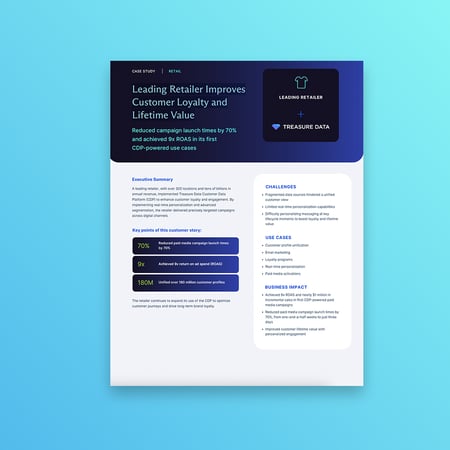
Executive summary
At Stripe International, the effective use of customer data has become a healthy habit. The apparel retailer and lifestyle brand started using customer data to improve its advertising results and grow its customer base. The results of its first CDP-driven data modeling were so compelling that the company decided to expand the use of its customer data platform (CDP). Stripe now leverages its deep understanding of customers to other parts of its business, including:
- Personalized customer journeys and targeted selling in its retail and lifestyle brand business
- Synching its supply-chain systems and hyper-localizing store inventory using CDP-powered projections of customer demand based on sophisticated customer behavior models
- Predictive analytics, targeting, and segmentation for better retail results
- Treasure Data CDP analytics and AI that power more company-wide digital
Challenges
Like many companies, Stripe initially wanted to evaluate its new customer acquisition efforts, including its advertising. It also hoped to use its new Treasure Data Customer Data Platform to understand its customers better, keep the brand experience of existing customers fresh and fashionable, and avoid cannibalizing existing sales with new online programs.
Pilot program successes later led to a supply-chain and inventory-management program that used predictive analytics to get inventory to the right stores – those most likely to sell it all – at the right time.
Solution
Treasure Data CDP unified data from many diverse sources, including:
- First-party data such as online and in-store purchase histories
- Advertising and behavioral data
- Second-party and third-party data
- IP location and NPS data
- Weather data
Next, Stripe used Treasure Data’s analytics capabilities for predictive scoring, targeting and segmentation, and lookalike analysis to find new prospects for Stripe’s lifestyle brands. The company modeled customer behavior to discover if high click rates and good lead generation were the result of effective advertising and relevant promotions, or other factors.
Results
The results were so impressive that Stripe decided to use the insights and predictive models of its customers’ behavior to understand how to fine-tune its supply chain. Their goal was to have the right merchandise, in the right stores, at the right moment for customers to find and buy what they need right away.
Today Treasure Data CDP updates and adjusts its AI-driven predictive analytics models in near-real-time, so that reordering from suppliers is continuously adjusted and expedited based on fresh incoming customer data.
This combination of CDP-driven automation and the improved experience for the store personnel yielded fruit right away. Following the launch of the system, the apparel division’s budget versus actual performance improved over the pre-CDP periods, as more frequent stock follow-ups led to fewer lost opportunities and higher sales.
Revenue attainment shot up from about 90% of goal to more than 160% of target in about three months. Encouraged by the success, Enomoto’s team also automated inter-store transfer management by building on the initial pilot system, which resulted in additional efficiency and estimated labor cost savings of 23.4 million yen, or about $220,000 per year.