
In the frenetic race to harness customer data, the "composable" customer data platform (CDP) has emerged as a seductive buzzword—a modular utopia promising flexibility and control. Yet, beneath this veneer lies a fragile edifice of risk, cost, and chaos. For global enterprises expanding across geographic regions, the stakes are too high for experimental gambles. Treasure Data CDP offers a stark counterpoint: a unified, reliable solution that eschews the pitfalls of patchwork systems.
Treasure Data vs Composability
Composable risks
| High risk of failure | Hidden costs | Compliance chaos | Vendor fatigue |
| Too many components introduce a high risk of system failures | Staff costs: Forced to fund a large team to manage: - Integrations - Interoperability - Maintenance - Compliance wrangling- Development - Training |
Difficult to maintain and audit global compliance for 5-7 vendors | Different vendor cultures |
| Composable architecture is still a relatively new concept with very little evidence it can handle scale | Exposes multiple security vulnerabilities across vendors, increasing breach risks | Disjointed Support, Sales, and Success teams | |
| Interoperability | Variable compliance across vendors | Strain on Procurement with multiple contracts | |
| Different roadmaps | Hidden usage/feature fees | Compromises regional compliance with gaps in global datacenter presence | Forced to negotiate multiple SLA environments |
| Extended deployments | Burdens IT with maintenance instead of driving innovation | ||
| Inconsistent AI strategy |
Treasure Data benefits
| Low risk of failure | Known costs | Achieved compliance | Vendor collaboration |
| Single unified CDP platform, white box focus | Known and predictable costs | One-stop global enterprise security, privacy, and compliance across all CDP components | Single CDP-focused culture |
| Proven scale | Buy only what you need | Global data centers isolating GEO data where needed | Single global support team |
| Built in interoperability with entire tech stack | Platform maintenance included | Purpose-built for global governance | Single contract, single SLA |
| Singular CDP-focused roadmap | Unified development | Standardized certifications, security, and audit reports | Single sales and customer success contacts |
| Rapid deployment | IT focus on high priority business projects (e.g. security, AI, etc) | ||
| Consistent AI strategy |
The fragility of too many moving parts
Modularity, the vaunted strength of composable CDPs, is its fatal flaw. Stitching together disparate vendors—each with idiosyncratic APIs, erratic update cycles, and performance quirks—creates a house of cards. A single misstep, a data sync failure, or an incompatible patch can cascade into a pipeline collapse.
This vulnerability scales exponentially for multinational companies spanning diverse regions. Treasure Data’s integrated platform, fortified by global data centers, delivers unassailable uptime and a single global security, compliance, and governance posture that eliminates risk.
The vision of composable CDPs was sold as a revolution in flexibility, but what’s unfolding looks more like chaos than progress. As composable players like Census, GrowthLoop, and Hightouch pivot to nebulous labels such as “universal data platform” or “compound marketing engine,” and others like ActionIQ and mParticle face debt-fueled acquisitions, the industry’s trajectory is raising eyebrows. These aren’t moves toward clarity—they’re warning signs. According to market analysts, the rush to redefine categories reflects a retreat from the very complexity composability introduced.
Enterprises, it turns out, aren’t clamoring to stitch together a patchwork of point solutions. Instead, they’re gravitating toward integrated, purpose-built platforms that deliver on long-standing CDP promises—real-time identity resolution, seamless activation, personalization, decisioning, and robust governance—without the operational headaches of a fragmented tech stack.
The Scalability Mirage
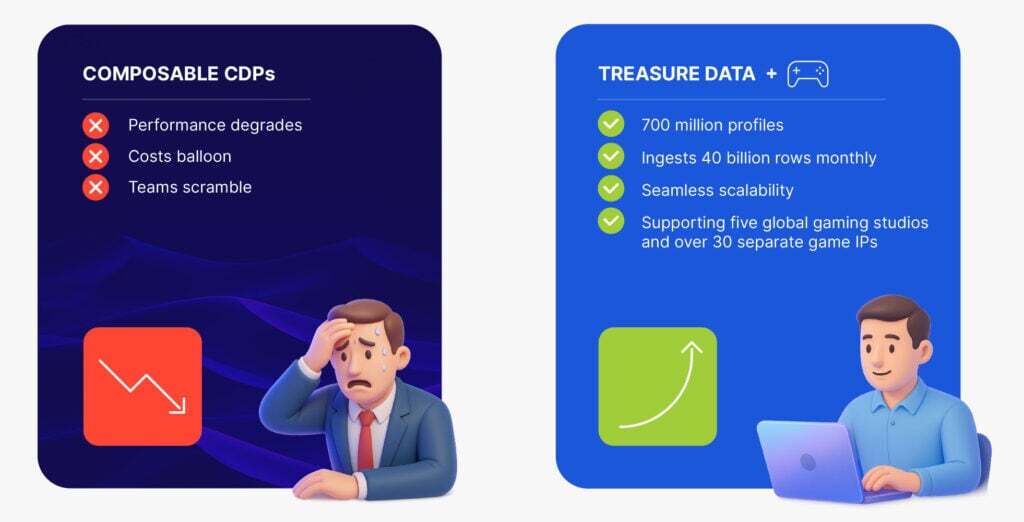
As data volumes surge, composable CDPs falter under the weight of manual oversight and ad hoc scaling. Performance degrades, costs balloon, and teams are left scrambling. Further, updates across the composable stack don't necessarily translate to other systems, yielding broken models, delays, and often a full stop of operations.
Contrast this with Treasure Data's seamless scalability: One of the largest publicly traded entertainment companies manages over 700 million profiles, ingests 40 billion rows monthly, and surpasses 15 billion activations a month across 30 different game IPs–without breaking a sweat.
Composability's promise of agility dissolves when growth exposes its brittle core. Regarding cost, composable CDPs often promise lower costs by letting you "use what you already have," mainly your data warehouse. But in reality, they don't eliminate compute expenses, they just shift them upstream.
Instead of paying your CDP vendor for data transformation and identity resolution, you're offloading that work to your warehouse. That means your Snowflake, Databricks, BigQuery, or Redshift instance is doing heavy lifting, more often, and for longer durations. In many cases, that means keeping your cluster live far more than before, which can dramatically inflate your compute bill.
So while it might look like you’re saving on vendor costs, you’re just moving expenses around, and potentially spending even more in the process.
Compliance: A house divided
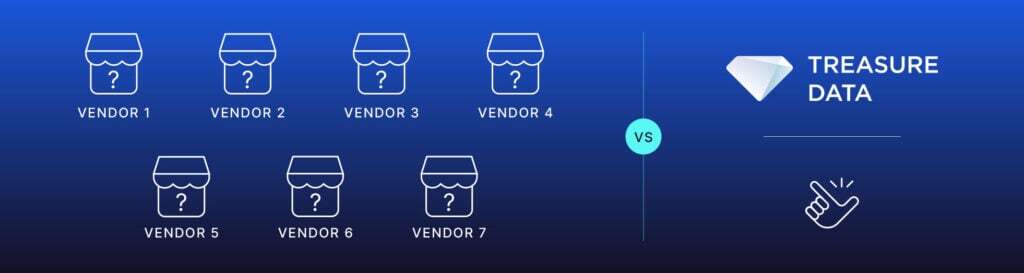
In an era of stringent data privacy—GDPR, CCPA, and JAPAC's labyrinthine of regulations.
Composable CDPs scatter accountability across a motley crew of vendors. Each brings its own security gaps, inviting breaches and audit failures that could levy millions in fines and erode trust.
A global mass media company joined Treasure Data in 2020, leaving a horrible composable experience. Plagued with compliance challenges, interoperability failures, and delays, it pulled the plug and moved to our enterprise CDP.
Treasure Data centralizes governance, to ensure uniform, ironclad compliance across regions. Fragmentation breeds chaos; unity begets control.
The hidden cost of a fragile ecosystem

Composable CDPs tout cost savings by leveraging existing data warehouses, but the reality is less rosy. Rather than eliminating compute expenses, they shift the burden upstream to platforms like Snowflake, Databricks, BigQuery, or Redshift. These systems end up handling intensive tasks like data transformation and identity resolution, running longer and racking up heftier bills. What appears as a vendor cost cut often masks a spike in overall expenses, leaving enterprises questioning the promised savings.
Composable CDPs claim of affordable "best-of-breed" tools—masks a litany of concealed costs:
- Staffing: Retaining a bloated team to wrangle integrations and maintenance is a costly gamble, exacerbated by turnover.
- Scaling or other fees: Predicting cost overruns from scaling is complicated.
- Engineering: Maintaining custom integrations across 5-7 vendors can exceed $500,000 annually, per industry benchmarks.
- Training: Mastering a constellation of platforms inflates onboarding expenses.
Treasure Data's transparent pricing and singular ecosystem offer savings at scale. - Lost opportunity cost via slow time to value: DIY projects take longer; Treasure Data's vertically integrated platform accelerates time to value. A global beauty company successfully migrated 90 audiences to Treasure Data CDP in under two months.
Deployment: The clock ticks louder
Assembling a composable CDP is a Sisyphean ordeal—vendor onboarding, integration testing, and workflow alignment stretch timelines to 12-15 months. Engineers and mid-management toil in the weeds, diverted from strategic imperatives.
Treasure Data Intelligent CDP, proven by a 90-day APAC rollout for a leading global retail brand, demonstrates that rapid deployment can coexist with robustness, offering a significant competitive edge when applied to North American and EMEA operations.
Vendor fatigue: Death by a thousand contracts
A composable CDP demands juggling five to seven vendors—each with distinct terms, escalations, and support silos. Procurement drowns in administrative quicksand, while executives lose sight of a splintered landscape. Studies peg multi-vendor oversight as inflating costs by 20-30%. Treasure Data's single-contract model supporting a global CDP deployment eliminates this burden, offering clarity and cohesion.
Conclusion: Proven triumph over trendy risk
The composable CDP is a tantalizing experiment, but enterprises demand certainty. Treasure Data's proven success model—scale-ready, compliant, and unwavering reliability—stands as a beacon for brands' global ambitions.
Treasure Data, unlike other CDPs, provides the agility and flexibility of composable (use the preferred Treasure Data's components and leave the rest) but with unwavering global compliance, interoperability, and scale that composable CDPs struggle with. And now with "zero-copy" CDPs emerging, often conflating their capabilities with composability, they, too, fall short. Treasure Data architecture offers the best of what composable or zero-copy CDPs claim to offer, with proven seamless customization affording modularity, interopability, and scalability.
Why wager on a fragile mosaic when a battle-tested solution awaits? The choice is clear: reject the hype, embrace the proven.