![AI Agent Platform: The Complete Guide to Building AI Agents on Customer Data [2026]](https://www.treasuredata.com/hs-fs/hubfs/the-complete-guide-to-building-ai-agents-on-customer-data-rti.jpg?width=760&height=550&name=the-complete-guide-to-building-ai-agents-on-customer-data-rti.jpg)
Forrester named agentic AI the top emerging technology for 2026. Gartner predicts that by 2028, 33% of enterprise software applications will include agentic AI, up from less than 1% in 2024. Yet BCG found that 74% of companies struggle to scale value from AI — not because of model quality, but execution and governance gaps. The message is clear: autonomous agents are moving from experiment to infrastructure — and the platform you choose determines whether your enterprise AI agents deliver ROI or just demos.
This guide covers everything marketing leaders and data team leads need to evaluate, build, and scale an AI agent platform on customer data — from architecture and use cases to testing frameworks and real-world results. Unlike listicles that compare developer-focused tools, this guide focuses on what makes AI agent software work in enterprise marketing, sales, and data operations — and why building them on a customer data platform (CDP) gives you an unfair advantage.
What Is an AI Agent Platform?
An AI agent platform is an enterprise software environment where teams build, test, deploy, and govern autonomous AI agents that take multi-step actions on live business data in real time — with human intervention only when necessary.
Unlike chatbots that follow scripts or copilots that suggest next steps, AI agents on these platforms reason over unified customer data as it flows in, execute workflows end to end, and learn from outcomes. They don't wait for nightly batch exports or stale data snapshots — they query live, governed data the moment a decision needs to be made.
An enterprise-grade AI agent platform typically includes:
- A unified data foundation — identity-resolved customer profiles that agents query in real time with full customer context, not batch exports from last night
- An agent builder — no-code or low-code tools for defining agent behavior, tools, and guardrails
- Knowledge bases — live connections to governed databases that reflect the latest customer interactions, not static document stores
- Multi-agent orchestration — the ability for agents to delegate tasks to other specialized agents
- Integration channels — deployment to Slack, Teams, web chat, webhooks, and embedded experiences
- Governance and testing — RBAC, audit logging, and automated test suites for production readiness
The distinction matters because many vendors label chatbots or copilots as "agents." A true AI agent platform supports autonomous, multi-step execution grounded in governed data — not just conversation.
AI Agents vs. Chatbots vs. Copilots: What's the Difference?
The terms get used interchangeably, but the differences matter. Autonomy is the differentiator.
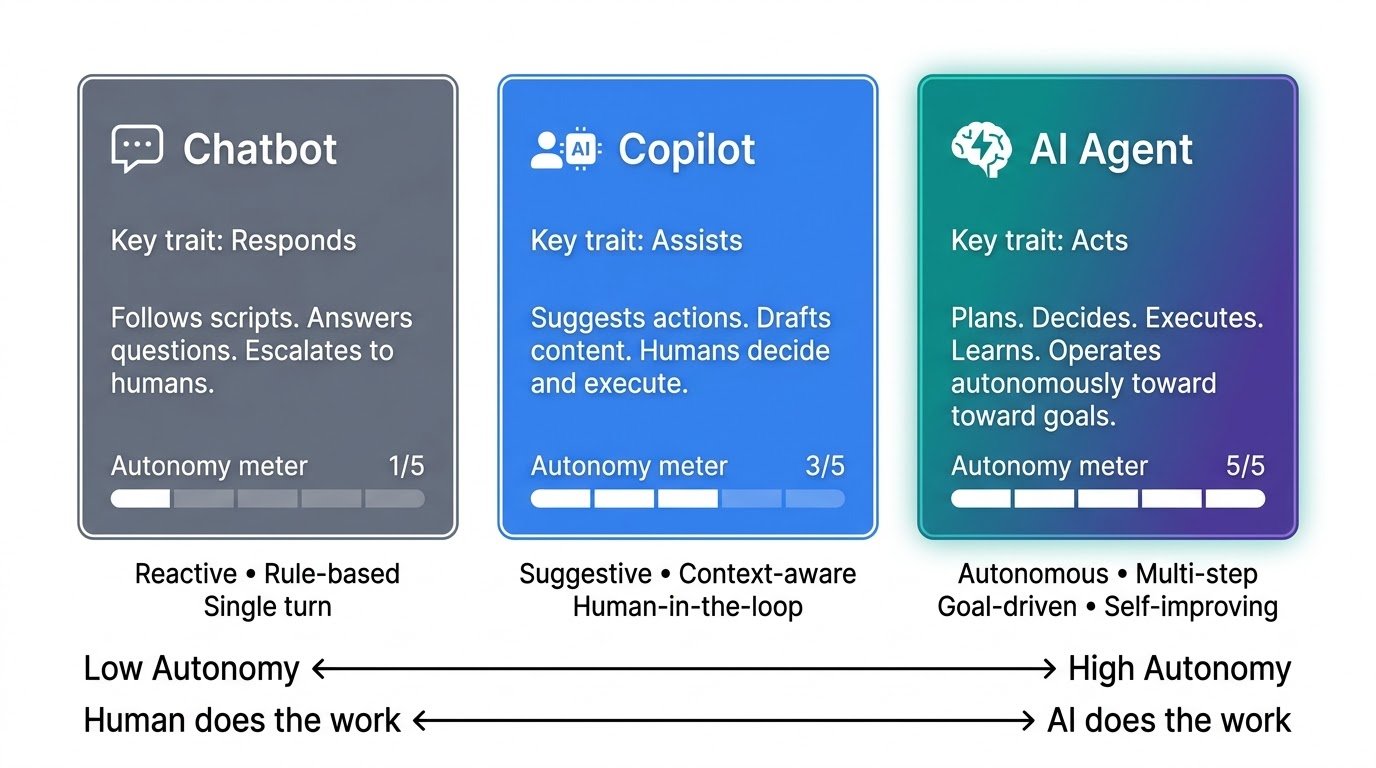
| Capability | Rule-Based Chatbot | AI Copilot | AI Agent |
|---|---|---|---|
| How it works | Follows decision trees and scripted responses | Suggests actions; human approves each step | Reasons, plans, and executes multi-step tasks autonomously |
| Data access | Limited to pre-loaded FAQs or a single database | Reads from connected systems on demand | Queries live customer data in real time across multiple sources — with full context on who the customer is, what they've done, and what they've consented to |
| Decision-making | None — routes to the next scripted node | Recommends; human decides | Makes and executes decisions within defined guardrails |
| Multi-step tasks | Cannot chain actions | Assists one step at a time | Orchestrates entire workflows: segment → content → activation |
| Learning | Static — must be manually updated | Improves suggestions over sessions | Iterates based on outcomes and feedback loops |
| Example | "Your order ships in 3-5 days" | "Here's a draft subject line — want me to send it?" | Discovers a high-value dormant segment, generates a re-engagement campaign, and activates it across three channels |
Key takeaway: If your "AI" requires a human to approve every action, you have a copilot. If it can plan, execute, and adjust on its own within governed boundaries — you have an agent.
AI Agent Platforms vs. Traditional AI Frameworks
Beyond the chatbot/copilot distinction, teams also confuse AI agent platforms with traditional AI frameworks (like calling an LLM API directly or using a prompt-chaining library). The difference is the gap between experimentation and production.
| Aspect | Traditional AI Framework | AI Agent Platform |
|---|---|---|
| Primary focus | Model invocation and prompt execution | Continuous agent execution and goal completion |
| Execution style | Stateless or short-lived requests | Long-running, stateful agents with memory |
| Data access | Manual API calls or static context windows | Live customer data access — real-time queries against governed databases with full customer context |
| Workflow support | Linear pipelines, predefined steps | Dynamic, multi-step, adaptive workflows |
| Multi-agent orchestration | External or manual | Built-in delegation and coordination |
| Governance | Added after the fact (if at all) | RBAC, audit logging, and guardrails from day one |
| Observability | Basic logs | Full tracing, dashboards, and behavior monitoring |
| Production readiness | Suitable for experiments and prototypes | Designed for enterprise production environments |
This is why Gartner predicts over 40% of agentic AI projects will be scrapped by 2027 — teams deploy agent capabilities without the runtime, orchestration, and governance that an enterprise-grade platform provides.
AI Agent Platform vs. AI Agent Builder: What's the Difference?
The terms "AI agent platform" and "AI agent builder" are often used interchangeably, but they serve different purposes in the enterprise AI stack. Understanding the distinction helps you choose the right AI agent tools and software for your organization.
What Is an AI Agent Builder?
An AI agent builder is a development tool—often featuring a visual, no-code or low-code interface—that lets teams design agent logic, configure prompts, connect tools, and define workflows. Think of it as the design studio where agents are created. Popular examples include Google Vertex AI Agent Builder, OpenAI Agent Builder, and open-source frameworks like LangChain and CrewAI.
Agent builders excel at prototyping. They let you quickly wire up an LLM to external APIs, test conversational flows, and iterate on prompts. However, most builders stop at the "build" stage—they don't provide the production infrastructure needed to run agents reliably at enterprise scale.
What Is an AI Agent Platform?
An AI agent platform goes beyond building. It provides the full production environment: data foundation, agent orchestration, knowledge management, governance, testing infrastructure, and integration channels. A platform is where agents are built, deployed, monitored, and scaled.
The critical difference is data. Builders connect to data sources on a per-agent basis. Platforms like Treasure Data provide a unified customer data foundation that all agents share—ensuring consistency, accuracy, and governance across every AI agent solution in your stack.
Why the Distinction Matters for Enterprise
| Capability | Agent Builder | Agent Platform |
|---|---|---|
| Visual workflow design | ✓ | ✓ |
| Prompt configuration | ✓ | ✓ |
| Unified customer data foundation | — | ✓ |
| Multi-agent orchestration | — | ✓ |
| Enterprise governance & compliance | — | ✓ |
| Production monitoring & observability | — | ✓ |
| Knowledge base management | Limited | ✓ |
| Cross-channel integration | Limited | ✓ |
Most organizations start with an AI agent builder for prototyping, then realize they need a full AI agent platform for production deployment. The pattern is predictable: a team builds a promising agent prototype, only to discover that moving it into production requires data pipelines, access controls, audit trails, and monitoring that the builder alone can't provide.
Bottom line: If you're evaluating AI agent tools and software for enterprise use, look for a platform that includes a builder—not a standalone AI agent tool pretending to be a complete software solution.
How AI Agent Platforms Work: Architecture Overview
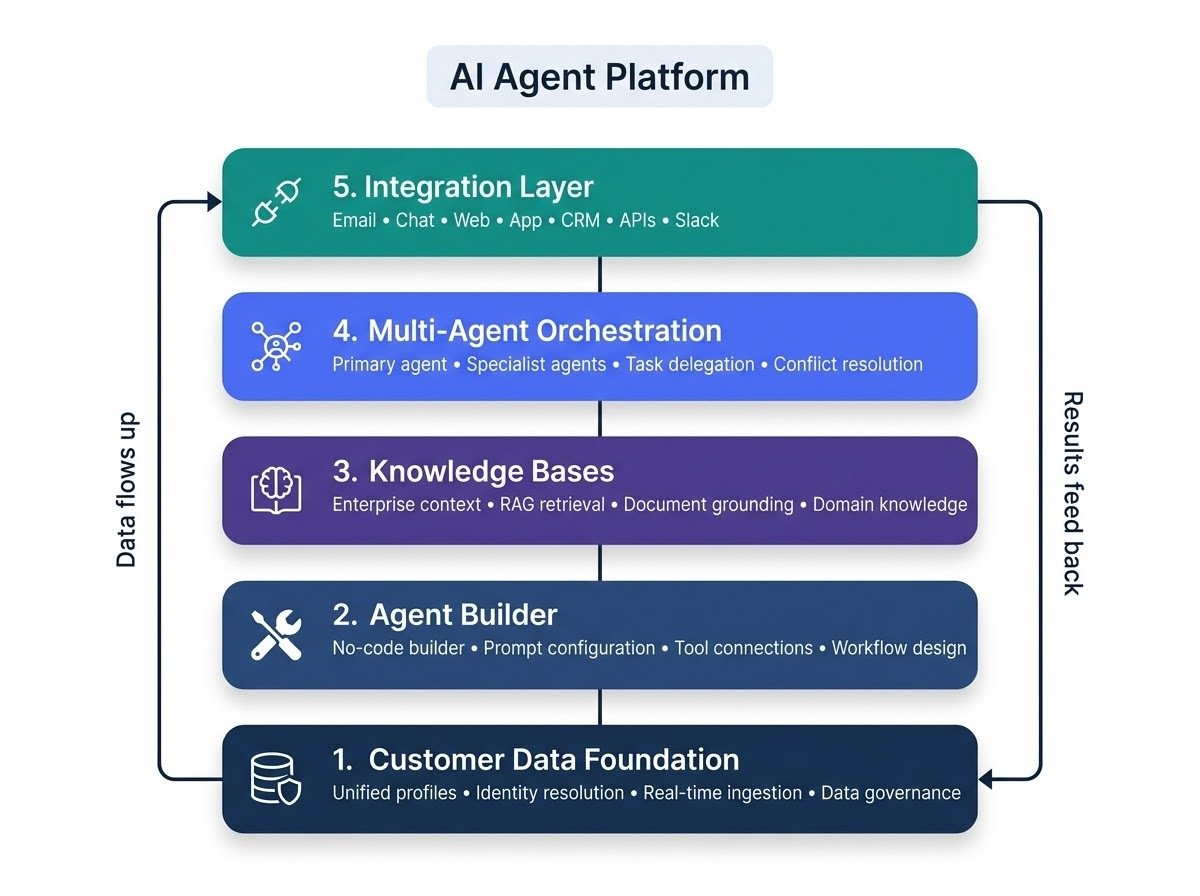
An enterprise AI agent platform is more than a prompt playground. It requires five architectural layers working together. Understanding this architecture helps you evaluate which platforms are genuinely built for enterprise AI agents — and which are wrappers around a chat API.
1. Customer Data Foundation
Agents are only as good as the data they reason over — and how current that data is. This is where a CDP changes the game: the clean, unified, real-time accessible customer data you need for agents already exists. The foundation layer provides:
- Identity-resolved profiles — A persistent, unified customer record (what Treasure Data calls the Diamond Record) that merges online/offline behavior, transactions, and consent signals into a single ID. In a CDP, this is already built and continuously updated — agents don't need to assemble it from scratch.
- Real-Time customer data access — Agents query governed databases in real time — not last night's batch export. Because a CDP already ingests and unifies data from hundreds of sources as it arrives, agents always have the full customer context: what someone browsed five minutes ago, which segment they belong to right now, what their consent preferences are today. When a customer abandons a cart at 2pm, the agent knows at 2:01pm — not the next morning.
- Schema flexibility — Data from any source — CRM, POS, web analytics, third-party enrichment — already ingested without rigid mapping to a proprietary data model. Agents inherit this flexibility on day one.
Without a clean, unified data layer, agents hallucinate, contradict themselves across channels, or act on incomplete information. Building agents on a CDP eliminates this problem at the foundation — the hardest part of data preparation is already done.
Why most AI agent platforms get this wrong: The majority of AI agent builders (LangChain, CrewAI, AutoGen, n8n) focus on orchestration and prompt engineering — but treat data as a "bring your own" problem. They assume you'll connect a vector store or API and figure out identity resolution yourself. For enterprise marketing, sales, and service use cases, that's a dead end. You'd spend months building the data layer that a CDP already provides: identity-resolved profiles, real-time behavioral data, consent-aware access controls, and governed query access. If you already have a CDP, the fastest path to production-grade AI agents is building directly on top of it.
2. Agent Builder
The agent builder is where teams define what an agent does:
- System prompts — Natural-language instructions (typically up to ~9,000 characters in Markdown) that define the agent's role, tools, output format, constraints, and decision-making flow. This is also where you encode brand voice: tone, vocabulary, phrases to avoid, and how the agent should represent your company in every interaction.
- Tool configuration — Which knowledge bases, APIs, or other agents the agent can call.
- Model selection — Choose the LLM behind the agent (e.g., Anthropic Claude, Amazon Nova, Meta Llama) based on task complexity and latency requirements.
- Guardrails — Rules that limit the agent's scope: read-only vs. write access, approved data tables, output format constraints, topic boundaries, and brand compliance. Guardrails ensure the agent stays on-brand — no off-tone responses, no unapproved claims, no messaging that contradicts your brand guidelines.
The best platforms offer a no-code/low-code interface where marketers define agents in plain English — no LLM engineering required. This matters for brand compliance: the people who own the brand voice can directly shape how agents communicate, without filing tickets to engineering.
3. Knowledge Bases
Knowledge bases connect agents to structured enterprise data — and this is another area where a CDP-native AI agent platform shines:
- Agents reference databases stored in the platform's data engine. Because the CDP has already unified and cleaned the data, agents don't need a separate ETL pipeline to access it.
- When a user asks a question, the agent translates it into a SQL query, and returns results grounded in real-time data — the same live data used for segmentation, activation, and reporting. No separate sync job, no stale cache.
- Text-based knowledge bases supplement system prompts with additional context — brand guidelines, tone-of-voice documentation, compliance rules, approved messaging, and product catalogs. This is how agents stay on-brand: they reference the same source of truth your marketing team uses, so every customer-facing response sounds like your company, not a generic LLM.
This is fundamentally different from RAG on static documents. Agents on a CDP query live, governed, identity-resolved data in real time — not a vector store of last month's PDFs. The data is already there, already clean, and continuously updated as new customer interactions flow in.
4. Multi-Agent Orchestration
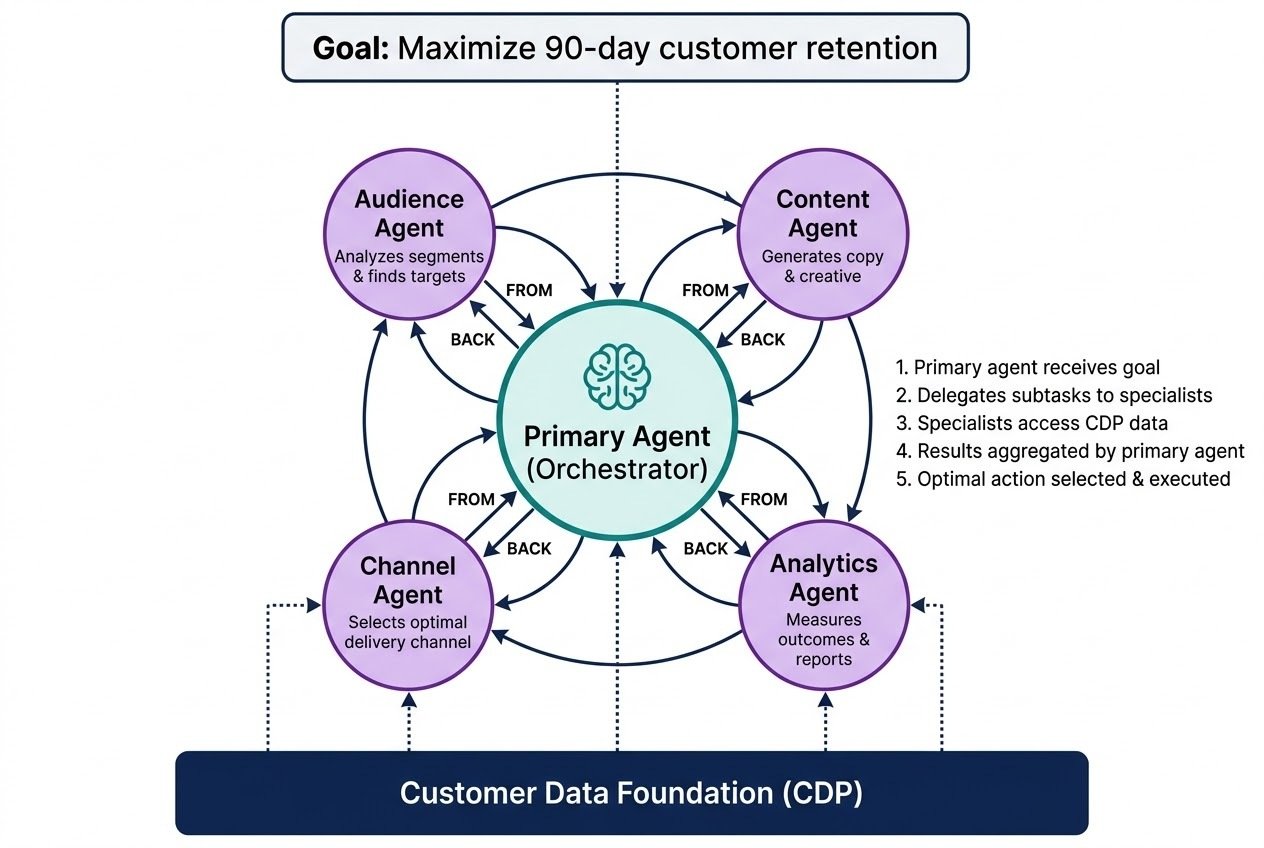
Complex workflows require multiple specialized agents working together:
- A primary agent (e.g., Marketing Super Agent) receives a request and delegates tasks to specialists.
- Specialist agents — Audience Agent, Content Generator, Deep Research Agent, Journey Optimizer — each handle one step.
- Results pass forward through the chain: discover segment → generate content → optimize journey → activate.
Orchestration logic is built into prompts and tool definitions, enabling fully autonomous end-to-end campaign execution.
5. Integration Layer
Agents need to reach users where they work. Enterprise platforms support multiple deployment channels:
| Channel | Use Case | Access Model |
|---|---|---|
| API | Embedded agent across all of your customer facing applications. | In-platform |
| Web Chat | Generic chat interface in the web interface. | In-platform |
| Slack | Team-facing agents for analytics, QA, campaign planning | External |
| Microsoft Teams | Self-service analytics for non-technical staff | External |
| Webhook / API | Custom integrations — Google Sheets, Gmail, apps | Programmatic |
The integration layer ensures agents aren't trapped inside a single UI — they meet users in the tools they already use.
AI Agent Use Cases for Marketing, Sales, and Service
AI agents for marketing, sales, and data teams go far beyond answering questions. Capgemini Research estimates AI agents have the potential to generate $450 billion in economic value by 2028 — yet only 2% of organizations have deployed agents at scale. The tables below show what data agents actually do in production — with real outcomes.
Marketing
| Use Case | What the Agent Does | Example Outcome |
|---|---|---|
| Audience Discovery | Queries customer data to find high-value segments humans would miss | Identifies dormant high-LTV customers ready for re-engagement |
| Campaign Planning | Analyzes historical performance data, recommends channel mix, timing, and budget | 3x faster campaign planning50% |
| Content Generation | Drafts copy grounded in brand voice, product data, and audience attributes | 50%+ reduction in manual content tagging |
| Journey Optimization | Evaluates journey performance, suggests branch changes, and A/B test configurations | Higher conversion rates with less manual testing |
| Multi-Touch Attribution | Connects touchpoints across channels, calculates contribution by campaign | Clearer ROI visibility without data-science tickets |
Sales
| Use Case | What the Agent Does | Example Outcome |
|---|---|---|
| Lead Scoring & Prioritization | Analyzes behavioral and firmographic data to rank leads by conversion likelihood | Reps focus on highest-intent prospects, improving win rates |
| Account Intelligence | Surfaces recent engagement signals, purchase history, and churn risk per account | Pre-call prep reduced from 30 min to under 5 min |
| Pipeline Forecasting | Aggregates deal stage data, historical close rates, and seasonal patterns | More accurate quarterly forecasts with less manual spreadsheet work |
| Next-Best-Action | Recommends the optimal outreach — email, call, content share — based on buyer stage and engagement recency | Higher reply rates through data-driven sequencing |
| Proposal & Content Assembly | Pulls relevant case studies, pricing tiers, and competitive positioning into draft proposals | Faster deal cycles with personalized, data-backed proposals |
Data & Analytics
| Use Case | What the Agent Does | Example Outcome |
|---|---|---|
| Data Onboarding | Guides users through data ingestion, mapping, and validation | Faster time-to-first-query for new data sources |
| Data Quality | Monitors tables for anomalies, null spikes, schema drift | Proactive alerts before bad data reaches campaigns |
| Self-Service Analytics | Translates natural-language questions into SQL, returns insights | Non-technical staff at Idemitsu query store-level data via Teams |
Security & Compliance
| Use Case | What the Agent Does | Example Outcome |
|---|---|---|
| Third-Party Risk Management | Reviews vendor security docs against compliance frameworks | SOC 2 review: 35 min → 2 min (TD Security Team) |
| Compliance Monitoring | Scans agent outputs for PII exposure, consent violations | Automated guardrails reduce compliance review cycles |
| Audit Trail | Logs every agent action, query, and response for regulatory review | Full auditability via Premium Audit Log |
How to Build and Test Enterprise AI Agents
Building enterprise AI agents follows a five-step framework. Whether you're deploying your first data agent or scaling a multi-agent orchestration, these steps apply.
Step 1: Define Scope and Goals
Start narrow. The most successful agent deployments begin with a single, well-defined use case — not a "do everything" super agent.
- Identify the workflow — What manual process takes the most time or has the highest error rate?
- Set success metrics — Time saved, accuracy improvement, cost reduction, or activation speed.
- Define boundaries — What should the agent not do? Write it down explicitly.
Step 2: Configure System Prompt and Tools
The system prompt is the agent's operating manual. Structure it with six sections:
- Role — Who is this agent? ("You are an audience strategist for [brand]...")
- Brand voice — How should the agent communicate? Define tone, vocabulary, phrases to use and avoid, and the personality your customers expect. An agent that sounds generic undermines trust.
- Tools — What can the agent call? (Knowledge bases, SQL queries, other agents)
- Output format — How should answers be structured? (Tables, bullet points, SQL, JSON)
- Decision flow — Step-by-step logic the agent follows for different request types
- Constraints — What the agent must never do (expose PII, fabricate metrics, bypass approval, make unapproved claims)
Best practice: Keep prompts under 9,000 characters. Use a text knowledge base for overflow context like brand guidelines or product catalogs.
Step 3: Ground in Governed Data
Enterprise agents must operate within governance frameworks — and a CDP provides these out of the box:
- RBAC (Role-Based Access Control) — Agents run with end-user permissions. A marketing manager's agent sees different data than an analyst's. On a CDP, these permission models already exist for segmentation and reporting — agents simply inherit them.
- Table-level access control — Define which databases and tables each agent can query. A CDP already enforces data access policies; agents respect the same rules.
- Audit logging — Every agent query, response, and action is logged in the platform's audit trail.
- Data residency — Ensure the platform processes data in the correct region for compliance (e.g., Amazon Bedrock's VPC isolation).
Step 4: Test Rigorously
Agent testing follows a progressive validation model:
| Stage | Method | Purpose |
|---|---|---|
| Workspace Chat | Interactive testing in the builder | Rapid prompt iteration and debugging |
| Automated Test Suites | Predefined input/criteria pairs evaluated by a judge agent | Regression testing and quality gates |
| User Acceptance Testing | Real users test with production-like data | Validate real-world usability |
| Security Red-Teaming | Adversarial prompts to test guardrails | Ensure the agent can't be tricked into leaking data or exceeding scope |
Automated test suites are critical for scale. Define test cases with user_input and criteria — a judge agent evaluates whether the response meets each criterion. This enables CI/CD-style testing for prompt changes.
Step 5: Deploy, Monitor, Iterate
- Hypercare period — Monitor the agent closely for the first 2 weeks. Track response quality, latency, and user satisfaction.
- Telemetry — Measure conversation count, resolution rate, escalation rate, and data queries per session.
- Prompt iteration — Refine the system prompt based on real conversations. Small wording changes can dramatically improve output quality.
- Blueprint and scale — Once stable, clone the agent as a template (blueprint) for other teams, regions, or brands.
How to Choose the Right AI Agent Platform
With dozens of AI agent solutions now available—from open-source frameworks to enterprise platforms—choosing the right one requires a structured evaluation. Use this evaluation framework when comparing vendors:
| Criterion | Why It Matters | Questions to Ask |
|---|---|---|
| Customer data foundation | Agents built on fragmented or stale data hallucinate and contradict. Unified, identity-resolved profiles with real-time customer context are non-negotiable. | Does the platform have its own identity resolution? Can agents access live customer data with full context (behaviors, segments, consent), or only static exports? Is the data already unified, or do you need to build a pipeline first? |
| Governance & RBAC | Without access controls, any agent is a data breach waiting to happen. | Do agents inherit user-level permissions? Is every action logged? Can admins restrict which tables an agent accesses? |
| Multi-agent orchestration | Real workflows require multiple agents collaborating — not a single chatbot. | Can agents call other agents? Is orchestration logic configurable, or hardcoded? |
| Testing framework | Untested agents are unreliable agents. Automated testing is essential for production. | Does the platform support automated test suites with evaluation criteria? Can tests run in CI/CD pipelines? |
| Integration channels | Agents locked inside one UI limit adoption. | Slack, Teams, webhook/API, embedded in existing tools — what's supported? |
| Model flexibility | No single LLM is best for every task. Lock-in to one model is a risk. | Can you choose between models (Claude, GPT, Llama, Nova)? Can different agents use different models? |
| Pre-built agents | Time-to-value matters. Starting from zero is expensive. | Are there production-ready agents for marketing, analytics, and operations? Can they be customized? |
| Brand compliance | Agents that go off-brand erode customer trust. Every customer-facing response must sound like your company. | Can you embed brand voice, tone guidelines, and approved messaging into agent prompts? Can non-technical brand owners update these directly? Can guardrails block off-brand or unapproved claims? |
A Note on Vendor Lock-In
Some platforms — particularly those attached to broader CRM or marketing cloud suites — require you to adopt their entire ecosystem before agents deliver value. Data must be mapped to proprietary data models. Segmentation depends on purchasing additional products. Pricing involves complex credit-based consumption models that are difficult to forecast.
The best AI agent platforms are vendor-agnostic: they sit on top of your existing stack, connect to any data source, and work with the channels and tools you already use. A CDP-native AI agent platform gives you the best of both worlds: the data foundation is already in place (unified profiles, real-time access, governance), and the platform connects to any downstream tool — not just one vendor's ecosystem. Evaluate total cost of ownership, not just the agent feature set.
Frequently Asked Questions
What is an AI agent platform?
An AI agent platform is enterprise software for building, testing, deploying, and governing autonomous AI agents that take multi-step actions on live business data without requiring human approval at every step. It typically includes an agent builder, knowledge bases, multi-agent orchestration, governance controls, and integration channels.
What is the difference between an AI agent and a chatbot?
A chatbot follows scripted rules and decision trees. An AI agent reasons over data, plans multi-step workflows, makes decisions within guardrails, and executes actions autonomously. The key differentiator is autonomy — agents act, chatbots respond.
How do AI agents use customer data?
AI agents on a CDP-native platform query live, identity-resolved customer profiles in real time using SQL — with full customer context: behaviors, segments, consent, and transaction history. They access the same governed data used for segmentation and activation — not static document stores or nightly exports — so every recommendation, segment, and action reflects who the customer is right now.
What are common AI agent use cases for marketing?
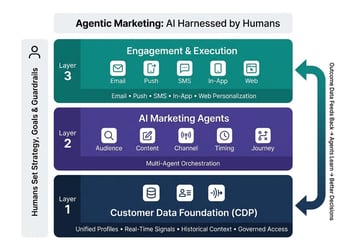
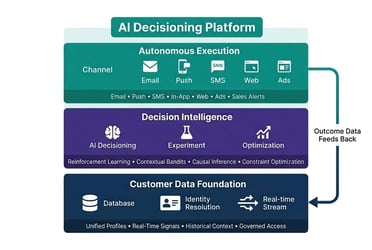
The most common AI agents for marketing handle audience discovery (finding high-value segments), campaign planning (recommending channel mix and timing), content generation (drafting copy grounded in brand and customer data), journey optimization, and multi-touch attribution. For a deeper dive, see our guides to agentic marketing and AI decisioning.
How do you test AI agents before deploying them?
Enterprise agent testing follows four stages: interactive workspace chat for rapid iteration, automated test suites with predefined criteria evaluated by a judge agent, user acceptance testing with production-like data, and security red-teaming with adversarial prompts.
Can I build my own AI agent without coding?
Yes. Modern AI agent platforms offer no-code or low-code agent builders where you define agents using natural language. You write a system prompt describing the agent's role, connect it to knowledge bases, set guardrails, and deploy — no LLM engineering required.
What's the difference between an AI agent platform and a standalone LLM API?
A standalone LLM API (like calling GPT or Claude directly) gives you a language model, but no data layer, no governance, no multi-agent orchestration, and no deployment infrastructure. An AI agent platform provides the full stack: data foundation, agent builder, testing framework, RBAC, audit logging, and integration channels. For enterprise use, the platform layer is what makes agents production-ready.
Which AI agent platform is best for enterprises?
The best enterprise AI agent platform depends on your data architecture and use cases. Key criteria include: a unified data foundation with identity resolution, role-based access control, multi-agent orchestration, automated testing, model flexibility (not locked to one LLM), and deployment across Slack, Teams, web, and API. If you already operate a customer data platform (CDP), building AI agents directly on top of it is the fastest path to production — the clean, unified, real-time data agents need is already there.
What's the difference between an AI agent builder and an AI agent platform?
An AI agent builder is a development tool for designing and configuring agents—typically offering visual workflows, prompt editors, and tool connections. An AI agent platform provides the complete production environment: the builder itself, plus a unified data foundation, multi-agent orchestration, enterprise governance, monitoring, and cross-channel integrations. For enterprise deployments that require accuracy, compliance, and scale, you need a platform, not just a builder.
Ready to see what AI agents can do for your team? Get a custom demo and explore the AI Agent Foundry.
Related resources: