Modular CDP: Built for Now, Ready for What’s Next
We don’t care where your customer data lives. We care where it performs.
Treasure Data’s governed, warehouse-native system is designed for real-time segmentation, enterprise-grade activation, and seamless collaboration between data and marketing teams.
Flexible options to match your data strategy and maturity
The industry’s most flexible architecture
Dual-mode architectures, all powered by zero-copy integration and data sharing with your existing data warehouse.
No redundant data pipelines
Enjoy governed, real-time customer data without maintaining complex ETL pipelines or duplicating data across systems.
Win-win for data and marketing teams
Use your data warehouse (if desired) as the performance engine while keeping the speed, intelligence, and orchestration power marketers need.
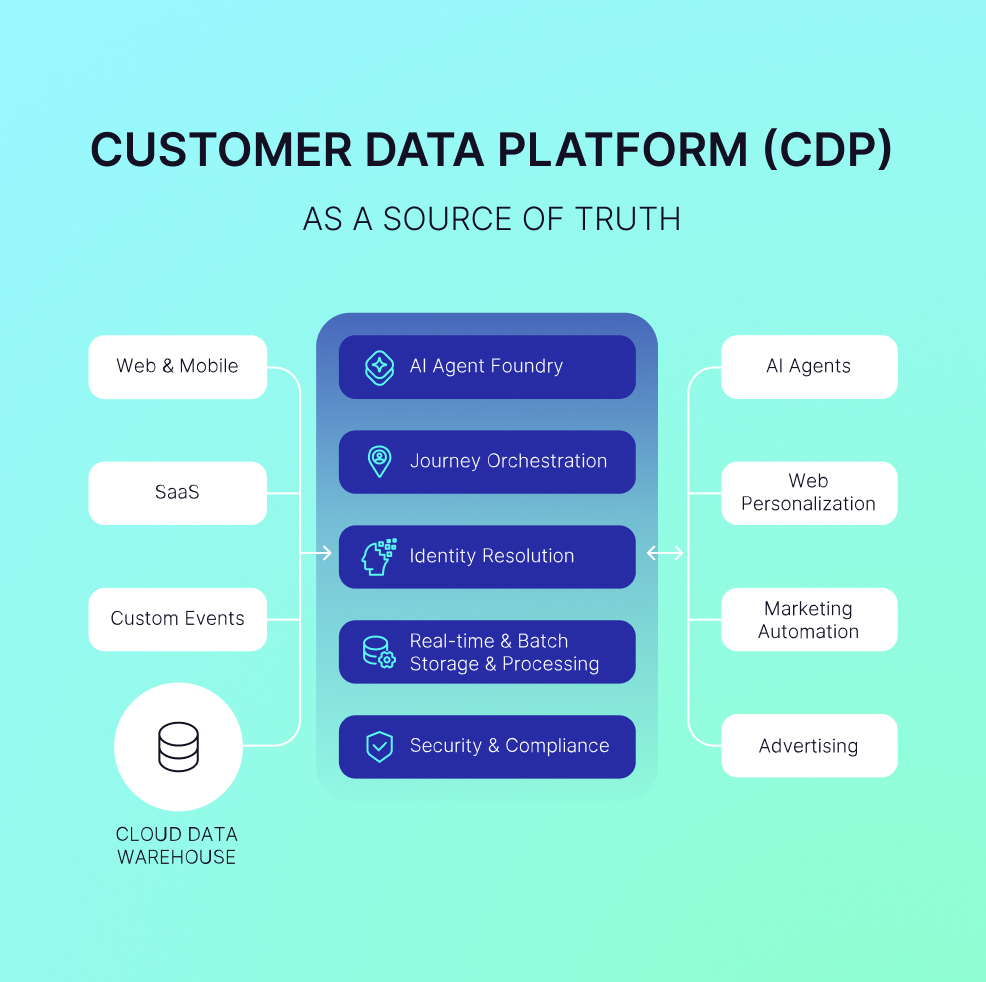
Complete CDP
How it works: Delivers an end-to-end customer data platform (CDP) experience with a single source of truth, integrated storage, real-time segmentation, journey orchestration, identity resolution, and activation — all within Treasure Data’s platform.
Ideal for: Brands that want a turnkey platform with unified profiles, low-latency activation, and baked-in intelligence.
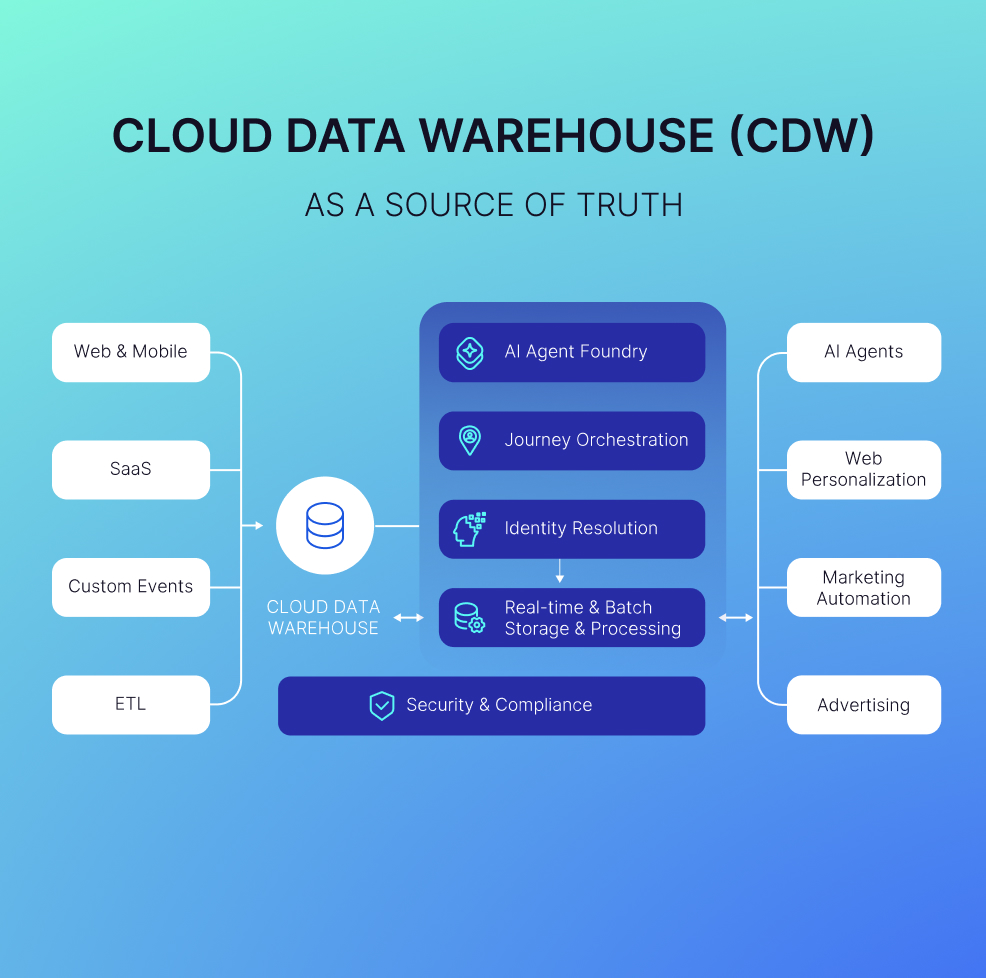
Composable CDP
How it works: When the cloud data warehouse (CDW) already exists as your single source of truth, Treasure Data builds a real-time cache of the customer 360 view from the CDW for instant customer data activations.
Ideal for: Mature data engineering teams that want to activate warehouse-native audiences across channels without relying on reverse ETL or rewriting marketing SQL logic.
Zero-copy integrations: Activate data without moving it

Many Databricks customers want to keep their data in the warehouse and still move at the speed of real-time activation. Our partnership with Treasure Data delivers exactly that. Together, we enable a truly hybrid CDP with secure, zero-copy access to governed data in Databricks with Treasure Data’s real-time profile cache for sub-second activation, audience orchestration, and agent-ready workflows. The result is faster time-to-value for AI-powered customer experiences without unpredictable compute costs so teams can iterate confidently, maximize warehouse ROI, and unify identity across marketing and IT.”
Key benefits of Modular CDP
Predictable total cost of ownership
Our “no compute” pricing is based on profiles and behaviors, not queries. Reduce storage and compute overhead without costly ETL pipelines.
Fresher data, faster time to value
Always operate on the most current version of customer data. Activate audiences without re-plumbing your data stack.
Stronger security and governance
Data never leaves your controlled warehouse, so it’s protected by existing governance and access rules.

Your CDP, your way: The most adaptable architecture awaits
FAQs
The answer is – it depends. Both a data warehouse and a CDP can be a single source of truth for customer data, but for different reasons.
Typically, a data warehouse is used for storing raw data, both structured and semi-structured, from across the enterprise, making it the best source of truth for the entire organization’s data. The data warehouse supports large data storage and processing, as well as complex querying.
A CDP is purpose-built for customer data. It also supports real-time personalization, omnichannel orchestration, and provides a UI accessible to marketing teams, making it ideal as a single source of truth for customer experience and marketing use cases.
Global 2000 enterprises no longer want to copy customer data across multiple systems just to make it usable. As a result, they are finding that CDPs and CDWs work best in tandem. Treasure Data’s flexible architecture introduces a new standard for how brands orchestrate, analyze, and activate customer data using zero-copy integration, zero-copy data sharing, and zero-copy data transfer capabilities that respect governance without slowing down marketing agility.
Zero copy with Treasure Data means your warehouse stays your source of truth, and Treasure Data CDP becomes your real-time activation engine.
For a decade, the industry relied on a “copy then compute” model: copy warehouse data into a CDP, copy it again into activation tools, and maintain endless ETL pipelines in between. This created cost, governance risk, and enormous operational drag.
Zero-copy and zero ETL architectures reverse this paradigm:
- Govern in place: Data stays in the warehouse, protected by existing governance and access rules.
- Eliminate redundant pipelines: Reduce or eliminate ETL and Reverse ETL complexity.
- Lower TCO: Stop paying to store (and reconcile) the same data multiple times.
- Operate on fresh data: Always activate on the latest warehouse state.
- Choose where compute runs: Push queries down to the warehouse or leverage CDP-speed compute when milliseconds matter.
Treasure Data’s architecture is not tied to a single warehouse or a single deployment philosophy. Instead, it delivers a flex-path that supports enterprises at any stage of data maturity.